

Time switches
Time switches: programmed switching of lighting, pumps and electrical loads from the board.
- Models: analogue, digital and astronomical time switches.
- Programming: daily, weekly or astronomical schedules calculated from sunrise and sunset.
- Compatibility: AE16/230 declares LED suitability; check each reference’s load limits.
- Mounting: DIN-rail format for modular electrical boards.


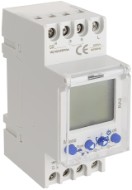

Time switches: choosing a clock, staircase timer or impulse relay
Solera time switches control lighting circuits and other services from the electrical panel. This category includes daily analogue clocks, a weekly digital time switch, a two-channel astronomical clock, a staircase timer and an impulse relay. Choose according to whether the circuit must operate at fixed times, follow the solar cycle, keep lighting on for a limited period or change state in response to impulses.
Comparison of the six references
| Reference | Function | Programming or distinguishing feature | 18 mm modules |
|---|---|---|---|
| R24 | Daily analogue clock | 24 h cycle; 15 min steps; 72 h reserve | 1 |
| R24R/3 | Daily analogue clock | 24 h cycle; 15 min steps; 150 h reserve | 3 |
| R168D | Weekly digital clock | 1 min resolution; 3-year reserve | 2 |
| RA2 | Digital astronomical clock | 2 channels; 1 min resolution; 4-year reserve | 2 |
| AE16/230 | Staircase timer | 30 s to 20 min timing range; suitable for LED | 1 |
| TLR16 | Impulse relay | Impulse control; 230 V AC coil; front manual control | 1 |
Applications and selection criteria
For the same schedule every day, R24 and R24R/3 provide 24-hour analogue programming, with different space requirements and reserves. R168D provides weekly programming, useful when office, shop or communal-service schedules vary by day. RA2 calculates sunrise and sunset times to control outdoor lighting, signs or shop windows, for example, from a panel with suitable installation conditions.
AE16/230 keeps staircase or passageway lighting on for the selected interval. TLR16 responds to impulse commands; it should not be confused with a time programmer or assumed to switch off automatically after a delay. These are different functions and devices are not interchangeable simply because they share a modular format.
The data sheets specify mounting on a 35 mm DIN rail and a 230 V AC, 50/60 Hz supply; for TLR16, distinguish the coil voltage from the switched-circuit voltage. Check contacts, load type, starting current, switching capacity and the reference’s environmental conditions before choosing. Where a contactor is needed, size the assembly for the load and control voltage; universal compatibility is not implied. These switching devices do not replace circuit protection.
Frequently asked questions
Does RA2 need a photocell to follow sunrise and sunset?
RA2’s astronomical function uses time calculations based on longitude, latitude and time zone, configured according to its instructions. It does not measure actual brightness: a change in cloud cover is not a change in astronomical time. Also check the date, time and seasonal settings.
Does the reserve keep loads running during a power cut?
No. The reserve maintains the clock or memory according to the model; it is not a backup power supply for connected lamps, pumps or contactors. Declared reserves are 72 h for R24, 150 h for R24R/3, 3 years for R168D and 4 years for RA2. Consult each manual for charging and retention conditions.
Does a 16 A rating allow any LED load or motor to be connected directly?
No. Switching capacity depends on load type and starting current, not just nominal current. AE16/230 declares suitability for LED, but this does not mean 16 A for every lighting assembly or extend that suitability to the whole range. Check the specific product limits and whether switching through a contactor is needed.