

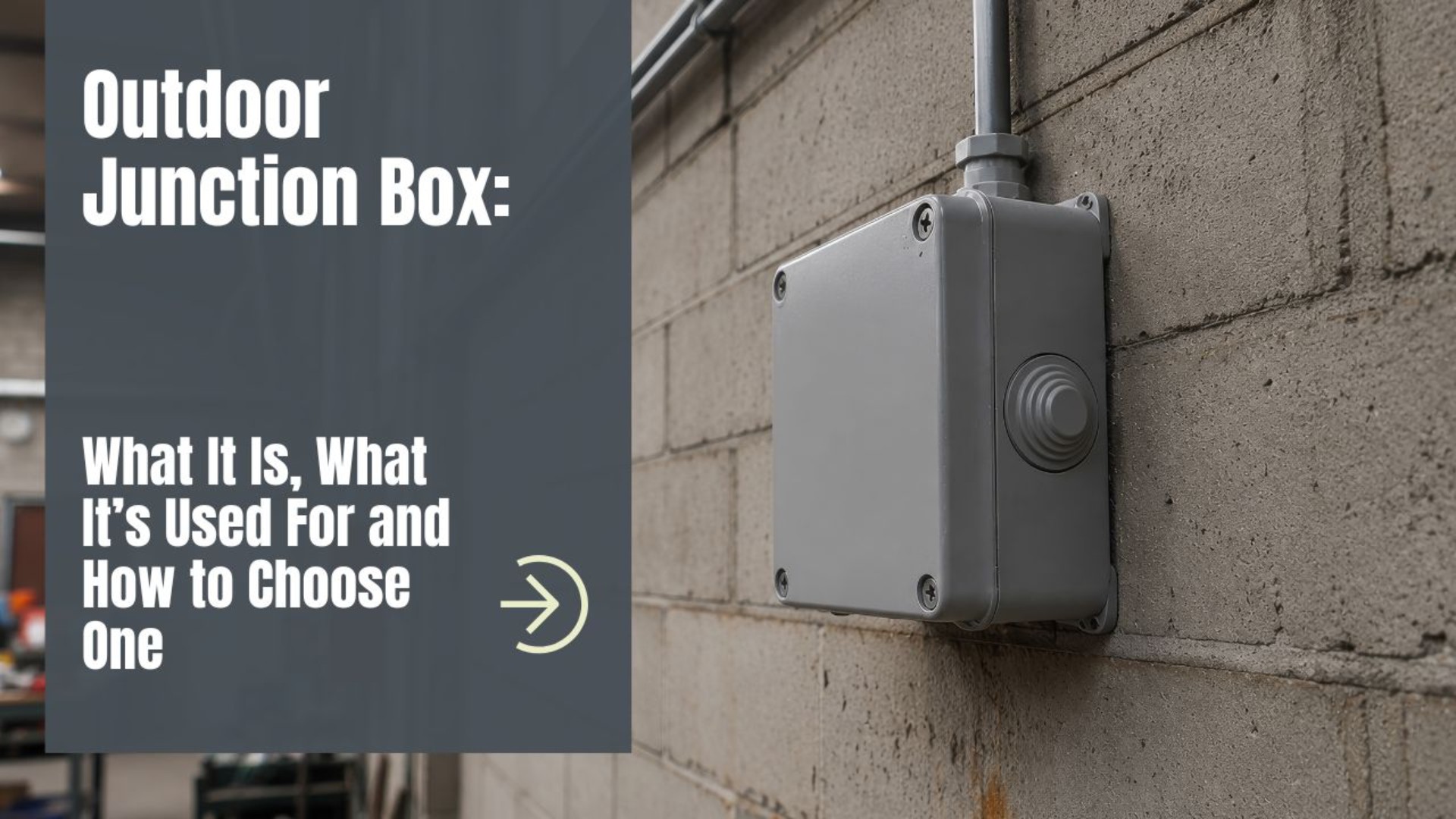
An outdoor junction box is an electrical enclosure designed to protect cable connections, joints or terminations in areas exposed to moisture, dust, splashes or outdoor conditions. Choosing the right waterproof junction box helps keep the installation safer, more organised and easier to maintain.
In outdoor electrical work, the box is not just a container. It protects the point where cables meet, branch or terminate, while keeping the connection accessible for inspection. This is especially important on façades, terraces, gardens, garages, warehouses, industrial areas and other locations where a standard indoor box would not offer enough protection.
To choose correctly, it is important to look at the installation environment, the number of cable joints, the type of cable entries, the internal space available, the closure system, the material and the IP rating. The goal is not simply to cover the wiring, but to protect the electrical connection in a way that matches the real exposure conditions.
What is an outdoor junction box?
An outdoor junction box is a protective electrical enclosure used to house cable joints, terminations or branch connections in outdoor or demanding environments. It provides a safer and more organised space for electrical connections that may be exposed to moisture, dust, splashes or environmental stress.
The key difference between an outdoor junction box and a standard indoor box is the level of protection required. Indoors, the enclosure may only need to keep connections organised and accessible. Outdoors, the box must also help protect them against water, dust, weather exposure and, in some applications, mechanical impact or sunlight.
This is why a proper outdoor electrical box is used not only in gardens or façades, but also in garages, workshops, warehouses, industrial buildings and humid areas. In all these cases, the box becomes part of the installation’s protection strategy.
When the application requires a compact enclosure for protected cable connections, a waterproof junction box is usually more appropriate than a basic indoor enclosure.
What is an outdoor junction box used for?
An outdoor electrical junction box is used to protect and organise electrical connections in exposed or semi-exposed areas. Its purpose is to prevent cable joints, terminations or branch points from being left unprotected or difficult to inspect.
Common uses include:
- Protecting electrical connections from dust, moisture and splashes.
- Housing cable joints in a protected and accessible enclosure.
- Organising wiring in surface-mounted or outdoor installations.
- Creating inspection points that can be opened for maintenance when needed.
- Supporting outdoor lighting circuits, especially on façades, gardens or terraces.
- Protecting cable terminations where cables enter or leave a section of the installation.
- Managing cable transitions between different areas or mounting surfaces.
In wet or humid areas, the enclosure choice becomes even more important. Solera’s guide to electrical safety in wet environments explains why moisture and electrical installations require careful product selection and installation practice.
Outdoor junction box, electrical box and waterproof enclosure: what is the difference?
The terms outdoor junction box, electrical junction box, waterproof junction box, outdoor electrical box and electrical enclosure are closely related, but they do not always mean exactly the same thing.
| Term | Main function | Typical use | Key selection criterion |
|---|---|---|---|
| Outdoor junction box | Protect cable joints, branches or terminations outdoors | Façades, gardens, terraces, garages, outdoor circuits | Exposure level, IP rating, entries and internal space |
| Electrical junction box | House electrical connections or junctions | Indoor or outdoor wiring points | Function, accessibility and cable capacity |
| Waterproof junction box | Protect connections against moisture or water exposure | Humid areas, outdoor locations, industrial environments | IP rating, sealing, closure and cable entry system |
| Outdoor electrical box | General outdoor electrical enclosure for connections or components | Domestic, commercial and technical installations | Size, material, mounting method and environmental protection |
| Electrical enclosure | Protect electrical components, terminals or assemblies | Industrial, commercial or technical installations | Application, capacity, protection level and maintenance access |
In practice, one product can fit several of these descriptions. A waterproof electrical box installed on a façade may also be an outdoor junction box, an electrical junction box and an inspection point, as long as it is correctly sized and suitable for the environment.
Where are outdoor electrical boxes commonly used?
Outdoor electrical boxes are used wherever electrical connections need protection from the environment. They are common in domestic installations, but also in commercial premises, industrial areas and technical settings.
Typical applications include:
- Façades, for lighting, cable transitions or auxiliary circuits.
- Gardens, for outdoor lighting, irrigation-related circuits or small equipment connections.
- Terraces and balconies, where moisture and partial exposure are common.
- Garages and basements, where dust, humidity or surface-mounted wiring may be present.
- Warehouses, where electrical connections may need robust surface protection.
- Industrial areas, where the enclosure may face dust, impact or demanding working conditions.
- Commercial premises, for local distribution, signage, lighting or auxiliary services.
- Machinery or equipment areas, where cable joints and terminations must remain protected and accessible.
For installations where the box is part of a wider outdoor system, the guide to outdoor electrical enclosures can help clarify how exposure, material, internal space and protection level influence the final choice.
What should a waterproof junction box include?
A waterproof junction box should include the features needed to protect the connection and make the installer’s work practical. Protection is important, but so are internal space, access and a reliable cable entry system.
The main features to consider are:
- Suitable material, resistant enough for the installation environment.
- Secure lid, to help maintain the protection of the enclosure.
- Reliable closure, such as screws, quarter-turn screws or pressure closing, depending on the model.
- Enough internal space, so cable joints or terminals are not overcrowded.
- Suitable cable entries, according to the cable, conduit or gland system used.
- Compatibility with cable glands, when the installation requires controlled entries.
- IP rating, matched to dust, moisture or water exposure.
- Mechanical resistance, especially in areas exposed to knocks or impact.
- Easy access for inspection, so maintenance does not require dismantling the whole installation.
- Suitability for wall or surface mounting, depending on where the box will be installed.
When the main requirement is to protect cable connections in demanding environments, Solera’s waterproof junction boxes provide several formats for professional electrical installations.
IP rating: why it matters in an outdoor junction box
The IP rating matters because it indicates the level of protection an enclosure provides against solid objects and water. In an outdoor junction box, it helps determine whether the box is suitable for the real exposure conditions.
A box installed under shelter does not face the same demands as one installed on an exposed wall, in a garden, in a dusty warehouse or close to water spray. The IP rating should therefore be selected according to location, exposure and the type of electrical connection being protected.
This article does not aim to explain every IP level in detail. The IP rating is treated here as one selection criterion. For a deeper explanation, Solera’s article on IP protection in electrical installations covers the meaning, levels and applications of IP ratings.
In locations where the box may also be exposed to physical impact, it is useful to consider IK protection as a complementary criterion. In sunny outdoor locations, UV protection in electrical materials can also be relevant when assessing long-term durability.
Cable entries, knockouts and glands: what to consider
Cable entries are critical because the protection of a waterproof electrical box depends not only on the box itself, but also on how cables or conduits enter it. A poor entry can compromise the protection of the whole assembly.
When choosing an outdoor junction box, consider:
- How many cables or conduits will enter the box.
- Where the entries need to be positioned for a clean routing path.
- Whether pre-formed entries are useful for faster installation.
- Whether cable glands are required for more controlled sealing.
- The diameter of cables or conduits to avoid forcing the entry point.
- How maintenance access will be affected by the cable layout.
Boxes with cable entry cones or pre-formed membrane entries can simplify routing and reduce installation time. This is why IP55 junction boxes with membrane entries are practical for many domestic, commercial and industrial jobs where quick cable routing is useful.
For installations that require a more controlled cable entry configuration, IP65 junction boxes without pre-formed entries allow the installer to define the entry points according to the layout, cable glands or accessory requirements.
How to choose the right size for an outdoor electrical junction box
The right size for an outdoor electrical junction box depends on the number of connections, the cable size, the bending space required and the need for future additions.
A box that is too small can make the installation harder to complete and harder to maintain. It may force conductors into tight positions, leave little space for terminal blocks or make inspection more difficult. A correctly sized box gives the installer enough room to work safely and keeps the internal layout clearer.
Before choosing, consider:
- Number of cable joints or terminations.
- Cable size and stiffness, especially with larger conductors.
- Terminal blocks or connectors that need to be housed inside.
- Bending space, so cables are not forced.
- Maintenance access, especially if the box may need to be inspected later.
- Future additions, such as extra cables or another branch circuit.
- Avoiding overcrowding, which makes the installation harder to read and maintain.
If the question is not only size but also enclosure type, Solera’s guide on how to choose the right enclosure is useful for comparing material, IP rating, internal capacity and application conditions.
Criteria for choosing an outdoor junction box
Choosing an outdoor junction box means matching the enclosure to the installation conditions, the cable layout and the level of protection required. The decision should not be based on price or external dimensions alone.
| Criterion | Why it matters | Practical recommendation |
|---|---|---|
| Location | Determines whether the box is sheltered, exposed, humid or dusty | Assess the real environment before selecting the enclosure |
| IP rating | Indicates protection against dust and water ingress | Match the IP rating to the level of exposure |
| Internal size | Affects cable bending, terminals and maintenance access | Avoid choosing a box that is too tight for the connections |
| Cable entries | Influence installation speed, sealing and cable routing | Choose pre-formed entries or controlled gland entries according to the job |
| Material | Affects durability, insulation and resistance to the environment | Select a material suitable for outdoor or demanding conditions |
| Closure system | Helps keep the lid secure and maintain protection | Consider pressure closing, screws or quick closure depending on access needs |
| Maintenance access | The box may need inspection after installation | Install it where it can be opened and checked safely |
| Future expansion | Additional connections may be required later | Leave spare internal space and consider possible extra cable entries |
Common mistakes when choosing an outdoor electrical box
The most common mistakes occur when an outdoor electrical box is treated like a standard indoor box or when the selection is based only on size and price.
- Choosing a box that is too small, leaving little room for cable joints or maintenance.
- Ignoring the installation environment, especially in exposed, humid or dusty locations.
- Using an indoor box outdoors, without suitable protection against moisture or water.
- Not considering cable entries, which can compromise the protection of the assembly.
- Leaving no room for maintenance, making later inspection more difficult.
- Choosing only by price, without assessing durability, closure or protection level.
- Ignoring water or dust exposure, even when the box is installed outdoors.
- Not planning future extensions, forcing the enclosure to be replaced later.
Another common mistake is to assume that all waterproof electrical boxes are equivalent. A compact terminal box for a simple connection does not serve the same purpose as a larger enclosure for several cable joints, conduit entries or industrial wiring points.
When to choose a Solera waterproof junction box
A Solera waterproof junction box is a suitable option when the installation needs a protected, accessible and practical enclosure for outdoor or demanding electrical connections.
For straightforward surface-mounted installations, boxes with prepared cable entries can make routing faster and cleaner. Where the installer needs greater control over cable entry position or wants to use specific glands, a box without pre-formed entries may be more appropriate.
This choice depends on the real use case. A small garden lighting junction, a façade connection, a garage branch point and an industrial wiring point may all require different sizes, entry systems and protection levels.
For projects involving outdoor cable joints, humid areas or exposed installations, Solera’s range of waterproof junction boxes includes solutions for domestic, commercial and industrial applications, with options designed for different protection levels, internal capacities and cable entry needs.
Frequently asked questions about outdoor junction boxes
What is an outdoor junction box?
An outdoor junction box is an electrical enclosure used to protect cable joints, branch connections or terminations in outdoor or demanding environments.
What is a waterproof junction box used for?
It is used to protect electrical connections from moisture, dust, splashes or outdoor conditions while keeping the connection organised and accessible for inspection.
What is the difference between a junction box and an electrical enclosure?
A junction box is mainly used for cable joints or connections. An electrical enclosure is a broader term that can include junction boxes, distribution boxes, cabinets and housings for electrical equipment.
Can a junction box be used outside?
Yes, but it must be suitable for outdoor use. The enclosure, cable entries, closure system and IP rating should match the installation environment.
What IP rating should an outdoor junction box have?
The required IP rating depends on exposure. A sheltered position may need a different level of protection from a garden, façade, industrial area or location exposed to water jets or heavy dust.
What is the difference between an outdoor electrical box and an indoor box?
An outdoor electrical box is designed to cope with environmental conditions such as moisture, dust, splashes or sunlight. An indoor box is normally used in more protected environments.
How do you choose the right size junction box?
Consider the number of cable joints, cable size, terminals, bending space, maintenance access and possible future additions. Avoid boxes that leave no room to work inside.
Why are cable entries important in a waterproof electrical box?
Cable entries are important because the protection of the enclosure depends on how cables or conduits enter the box. Poorly planned entries can reduce the effectiveness of the seal.
Conclusion
An outdoor junction box should be chosen according to the environment, the type of electrical connection, the internal space required and the cable entry system. It is not simply a box to hide wiring; it is part of the protection and maintenance strategy of the installation.
The right choice depends on location, IP rating, internal size, cable entries, material, closure, maintenance access and possible future expansion. It is also important to decide whether the installation benefits from prepared cable entries, a more controlled gland configuration or a larger enclosure for multiple connections.
For outdoor electrical connections, humid environments or demanding installation conditions, Solera’s waterproof junction boxes provide a practical route to protect cable joints, terminations and branches in domestic, commercial and industrial applications.