

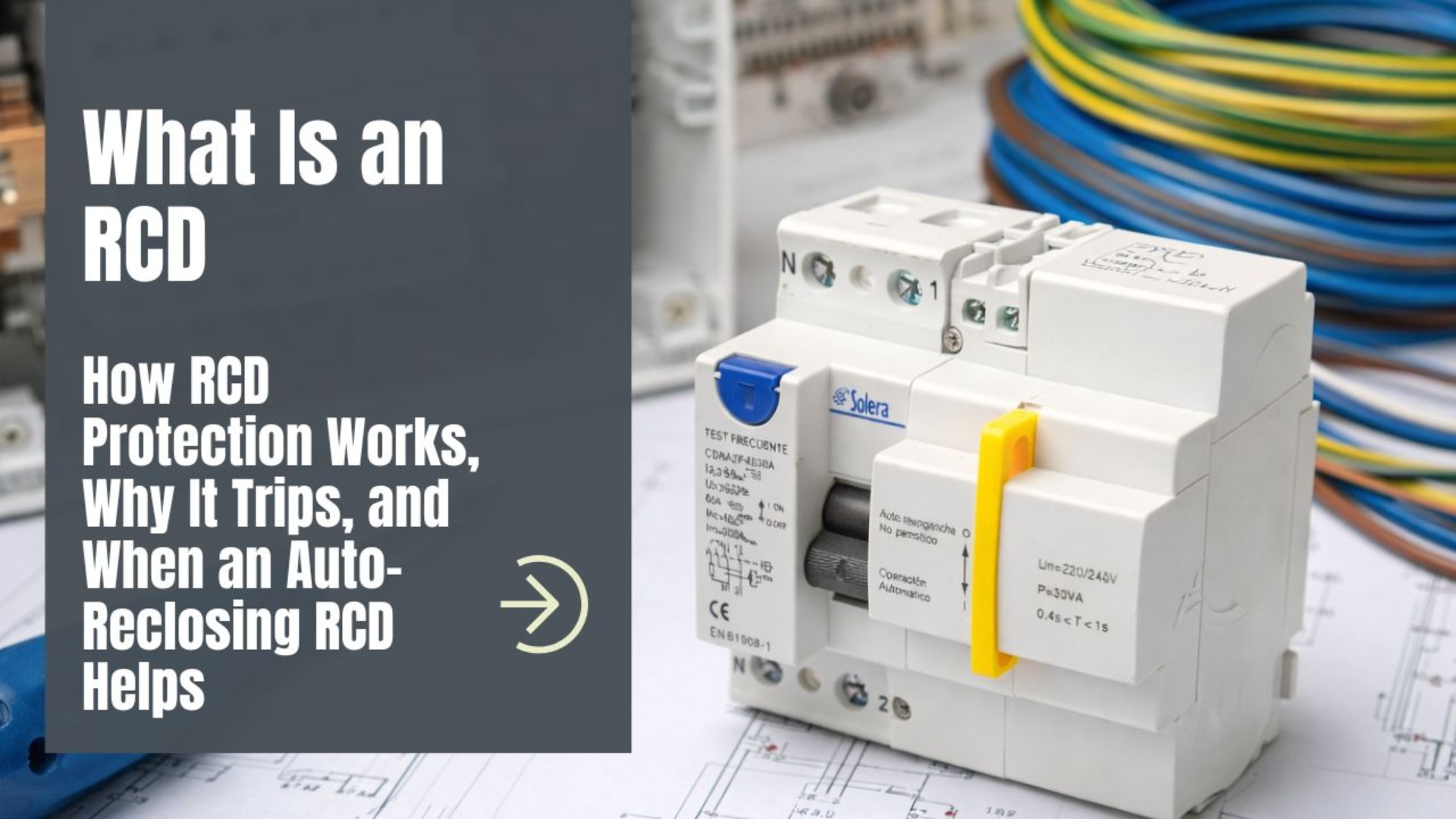
An RCD is one of the most important safety devices in a modern electrical installation. In UK everyday language, people often search for terms such as RCD switch, RCD protection, RCD fuse box, residual current device or simply what is an RCD. They are all pointing to the same core question: how does this device protect people, why does it trip, and what is the best way to use it in a home or small commercial installation?
If you are planning a new consumer unit, upgrading an older board, or trying to understand repeated tripping, it helps to separate three ideas clearly. First, what an RCD actually does. Second, how it differs from devices such as an MCB or an RCBO. Third, when a more advanced option such as an auto-reclosing RCD or auto-reset RCCB can be worth considering.
In this guide, we will explain all of that in plain English, using the terms most commonly searched in the UK. We will also connect the topic with related Solera resources, from consumer unit guidance to circuit breaker basics, so the article works both as an SEO page and as a genuinely useful reference for users and AI-driven search systems.

What does RCD stand for?
RCD stands for Residual Current Device. Its job is to detect an imbalance between the current flowing out through the live conductor and the current returning through the neutral. If there is a difference, the device interprets that as earth leakage and disconnects the circuit.
That imbalance matters because it can indicate that current is flowing somewhere it should not: through damaged insulation, through moisture, through metalwork, or in the worst case through a person. That is why RCD protection is such a fundamental part of electrical safety.
On Solera’s English site you will also see the term RCCB, which stands for Residual Current Circuit Breaker. In practice, many people use RCD as the broad everyday term and RCCB as the product-specific name for a device that provides earth-leakage protection but not overload or short-circuit protection on its own.
What is an RCD in electrical installations?
An RCD is a protective device installed in a consumer unit or distribution board to reduce the risk of electric shock and help disconnect the supply when dangerous earth leakage is detected. It is one of the core protective layers in a domestic or tertiary installation, alongside devices such as MCBs, RCBOs and surge protection devices.
In a typical home setup, the RCD may protect a group of outgoing circuits, such as sockets, lighting or appliance circuits. In other layouts, especially more selective or more compact boards, an RCBO may be used per circuit instead. That is why the question is not only what is an RCD?, but also what is the best protection strategy for this board?
If you want a wider view of how these devices fit inside the board, this article is a useful companion: Home Electrical Panel: Complete Guide & Diagrams.
How does an RCD work?
The principle is simple. An RCD continuously compares the current leaving on the live conductor with the current returning on the neutral. Under normal conditions, those values should match. If some current escapes to earth because of a fault, the values no longer balance. As soon as the difference exceeds the set sensitivity, the RCD trips and disconnects the supply.
For many residential applications, a 30 mA RCD is a common choice because it is designed for personal protection. Solera’s English product range includes, for example, Type A RCCB solutions and also Type AC RCCB options, depending on the application and the installation design.
That basic operating principle also explains one of the most searched UK questions: what causes an RCD to trip but not an MCB? The answer is usually that the problem is leakage to earth, not overload or short circuit. An MCB reacts to overcurrent. An RCD reacts to imbalance caused by earth leakage.
What does an RCD do — and what does it not do?
An RCD is extremely important, but it is not a “do everything” device. It is designed to detect earth leakage and disconnect the supply when a dangerous imbalance appears. It does not replace the role of a circuit breaker.
This distinction is essential:
- RCD / RCCB: protects against earth leakage and shock risk.
- MCB: protects against overload and short circuit.
- RCBO: combines earth-leakage protection and overcurrent protection in one device.
Solera explains that distinction clearly in its article on materials needed to assemble an electrical panel, where the basic roles of RCCB, RCBO, MCB and SPD are laid out together. That is also why many UK users search for RCBO meaning when comparing consumer unit options.
RCD, RCCB and RCBO: what is the difference?
This is one of the most useful sections to get right, especially for UK search intent.
| Term | Meaning | Main function | Typical use |
|---|---|---|---|
| RCD | Residual Current Device | Generic name for earth-leakage protection | Everyday UK search term |
| RCCB | Residual Current Circuit Breaker | Earth-leakage protection only | Protecting grouped circuits in a consumer unit |
| RCBO | Residual Current Breaker with Overcurrent | Earth-leakage + overload + short-circuit protection | Per-circuit protection and improved selectivity |
In practical terms, many people say “RCD” even when they are looking at an RCCB in the board. The broader point is that the protection strategy matters more than the label alone. In some boards, grouped RCD protection works well. In others, using more RCBOs improves fault isolation and reduces nuisance loss of power across multiple circuits.
What causes an RCD to trip?
This is one of the strongest question-based topics in UK search, and for good reason. An RCD can trip for several very different reasons, and understanding them saves time.
1) A genuine earth fault
This is the classic case. Damaged insulation, a faulty appliance, moisture ingress or a conductor touching earth can all create leakage that causes the RCD to trip.
2) Moisture or water ingress
Outdoor equipment, garages, garden circuits, bathroom accessories or damp utility areas can produce leakage paths that only appear under certain conditions.
3) Faulty appliances
A kettle, washing machine, oven, freezer, heater or even a charger can develop internal leakage. One of the quickest practical checks is to unplug suspect appliances and test whether the tripping stops.
4) Accumulated leakage from many electronic loads
Modern installations contain more electronics than ever: LED drivers, switch-mode power supplies, chargers, IT equipment, controls and inverters. Even when each device leaks only a tiny amount, the combined effect can become significant.
5) Neutral-earth issues or poor installation practice
Incorrect wiring, borrowed neutrals, damaged cables or loose terminations can all create hard-to-diagnose tripping behaviour.
If you are troubleshooting repeated tripping, these related guides are worth reading alongside this one: What Is Electrical Overload, What Is a Short Circuit and Why Does It Happen? and Electrical preventive maintenance: safety guide.

What causes an RCD to trip but not an MCB?
This question deserves its own section because it matches a common real-world diagnostic scenario. If the RCD trips but the MCB does not, the problem is usually not excessive current draw. Instead, it points towards earth leakage or insulation failure.
The MCB only reacts when current is too high because of overload or short circuit. The RCD reacts when current “goes missing” from the intended path. That means you can have a circuit drawing normal current overall while still leaking enough to earth to trip the RCD.
In a house, that often means the issue is with an appliance, dampness, wiring damage, accumulated leakage or an installation fault. It is one of the clearest examples of why RCD protection and overcurrent protection are complementary, not interchangeable.
Type A RCD, Type AC RCD and why the distinction matters
Another strong search theme in the UK is RCD types, especially Type A RCD. That is because not all residual-current devices detect the same waveform conditions in the same way.
Without getting lost in excessive theory, the practical point is this: in modern installations with electronic equipment, Type A is often the more relevant choice because it is intended for applications where pulsating DC components may be present. Solera’s English catalogue includes Type A RCCB products, while Type AC products are also present for more conventional loads.
That does not mean “use Type A everywhere without thinking”. It means the device type should match the load profile and the installation design. In homes with a growing number of electronics, this has become increasingly important.
What about nuisance tripping? When a super-immune RCD helps
Sometimes the problem is not a dangerous permanent fault, but repeated unwanted tripping caused by harmonics, switching transients or the combined effect of many electronic loads. That is where a super-immune RCD can make sense.
Solera’s article What Is a Super-Immune RCD and Why Use It? explains this in detail. The core idea is that a super-immune RCD still provides residual-current protection, but with improved resistance to nuisance tripping caused by electrical disturbances. Solera also has super-immune RCD products in its English range.
This is important because many users jump straight from “my RCD keeps tripping” to “I need an auto-reset device”. In reality, some installations first need a better RCD type, a better circuit split, or proper fault-finding before automatic reconnection is considered.
When an auto-reclosing RCD or auto-reset RCCB makes sense
Although auto-reclosing RCD is not the primary UK keyword cluster, it is still commercially relevant when continuity of supply matters. Solera’s English catalogue includes an auto-reset RCCB for this purpose.
An auto-reclosing RCD does not replace the protective function of the device. It still trips when leakage is detected. The added value is that it can attempt to restore the supply automatically after checking whether the fault has cleared. This is especially useful where a temporary trip could cause disproportionate inconvenience.
Typical examples include:
- Second homes left unoccupied for days or weeks.
- Fridges, freezers or alarm systems that should not stay off for long after a temporary trip.
- Remote or hard-to-access installations where a manual reset is inconvenient.
- Small service-critical circuits where restoring supply quickly matters.
Solera’s CBRA2P4030A auto-reset RCCB is a 2P, 40 A, Class A, 30 mA device with 6 kA breaking capacity, mounted on DIN rail, with up to 6 automatic reset attempts, and it carries UK marking on the English product page. Those details make it a useful example when writing about this category in English.
When an auto-reclosing RCD should not be used as a “quick fix”
This point matters for both SEO quality and user trust: an auto-reclosing device is not a shortcut around proper diagnosis. If an RCD trips repeatedly because of damaged insulation, moisture ingress, a failing appliance or a wiring fault, the right answer is to investigate and repair the installation.
Automatic reconnection is best thought of as a continuity-of-service feature, not as a substitute for electrical fault-finding. If the fault is still present, the device should not keep restoring the circuit as though nothing is wrong. That is why professional assessment remains essential.

RCD protection in a modern UK-style consumer unit
In the UK context, users often search for RCD fuse box when they actually mean the consumer unit and the arrangement of protective devices inside it. From a technical point of view, a good modern board usually needs more than one protective layer:
- MCBs for overload and short-circuit protection.
- RCDs / RCCBs / RCBOs for residual-current protection.
- SPDs where surge protection is appropriate.
- Correct enclosure choice, labelling and maintenance access.
For the broader context of board design and protective coordination, these Solera resources are useful: Home Electrical Panel: Complete Guide & Diagrams and Electrical Overvoltage: What It Is and Causes.
Frequently asked questions about RCDs
What is an RCD switch?
It is the everyday name many users give to an RCD. Strictly speaking, it is a device that disconnects the circuit when it detects residual current or earth leakage.
What does RCD stand for?
Residual Current Device.
How does an RCD work?
It compares live and neutral current. If there is an imbalance above its set threshold, it disconnects the circuit.
What is RCD protection?
Protection against electric shock and earth-leakage faults by automatically disconnecting the supply when dangerous leakage is detected.
What is the difference between RCD and RCBO?
An RCD or RCCB provides residual-current protection. An RCBO combines that with overload and short-circuit protection in a single device.
Why does my RCD keep tripping?
Common causes include faulty appliances, moisture, damaged insulation, wiring issues or cumulative leakage from electronic loads. In some cases, the better answer is a different RCD type or board design, not just a reset.
Conclusion
If you want to rank well in the UK for this topic, the strongest route is to lead with RCD, RCD protection, what is an RCD, how does an RCD work and what causes an RCD to trip. That matches the real way people search. From there, it makes sense to introduce RCCB, RCBO, Type A RCD and, as a secondary but commercially valuable topic, the role of an auto-reclosing RCD.
That is also the most natural fit with Solera’s English content and product structure. You can continue exploring the topic through Solera’s super-immune RCD guide, its auto-reset RCCB, the board assembly article and the general Solera English site.