

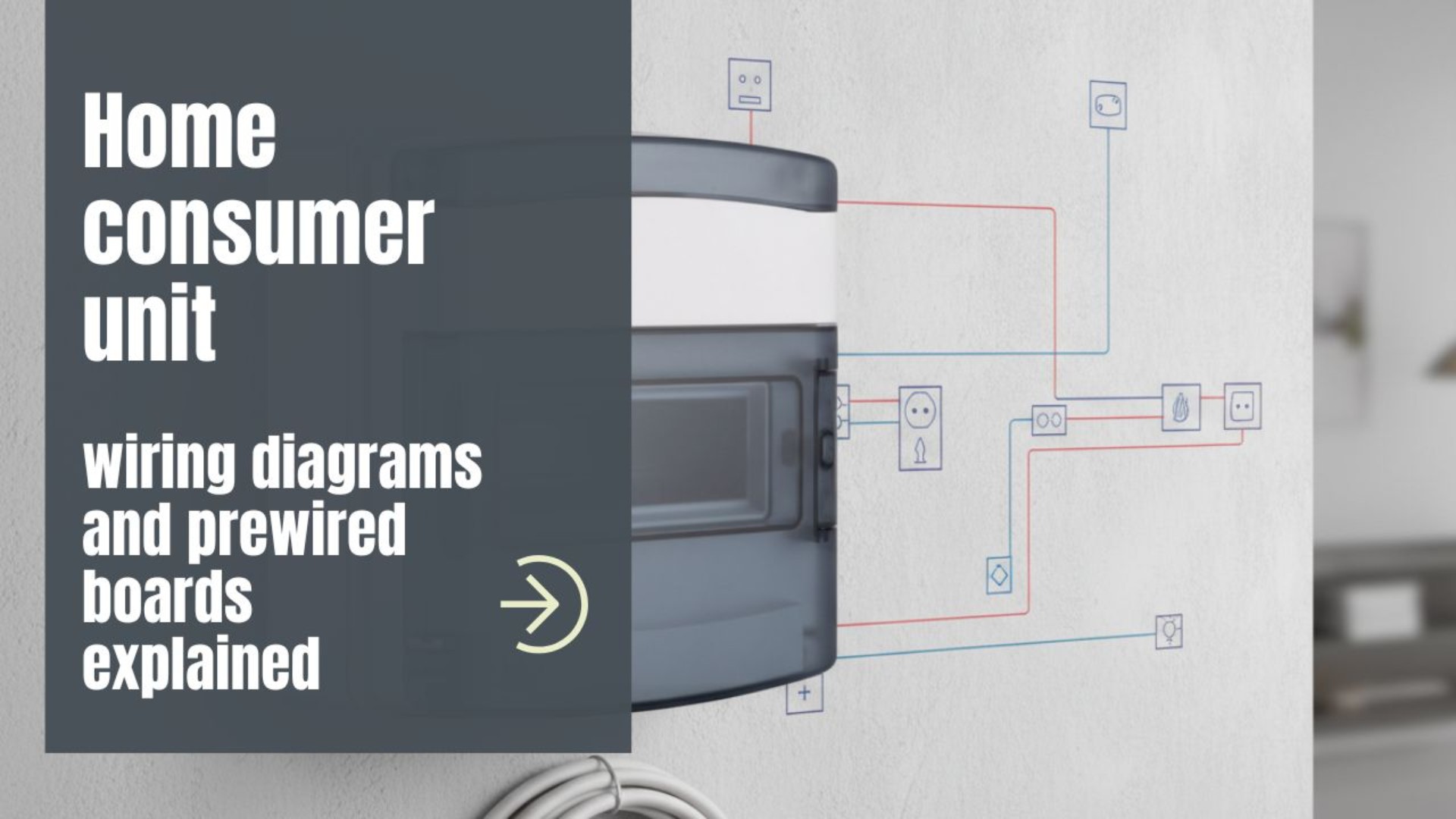
In a typical home installation, the consumer unit (also called a distribution board) is the heart of the system: it distributes power to every circuit and, more importantly, it coordinates the protections that keep people, wiring and appliances safe.
In this guide we’ll cover three things installers and specifiers deal with constantly: how a home electrical wiring diagram (including the single-line diagram) is structured, what “basic electrification” usually means in practice, and when a prewired consumer unit (pre-assembled / pre-mounted board) is the smartest option.
If you also need to size or select a board layout quickly, Solera provides a practical tool for this: the Reference configurator by housing type.
What is a consumer unit in a house?
A home consumer unit is the enclosure and internal assembly where protective devices are installed on DIN rail(s). From here, power is distributed to lighting, sockets, cooking appliances, HVAC, EV charging (if present), and other dedicated loads. The board also includes devices that respond to faults such as overload, short circuit, earth leakage and overvoltage.
If you want a refresher on the fundamentals of protective devices before diving into diagrams, these resources help: circuit breaker basics, overload (definition, causes, prevention), and short circuits explained.

Basic electrification in a home: what it typically includes
“Basic electrification” is often used as shorthand for a standard residential scope: enough circuits and protections to cover core services (lighting, general sockets, cooking area, and key dedicated loads), with a layout designed to be safe, maintainable and expandable.
In practical terms, good design usually aims for:
- Clear circuit separation (avoid mixing unrelated high-load circuits).
- Selective protection so a single fault does not drop the entire house.
- Room for growth (spare modules and tidy routing for future circuits).
- Labelling and documentation for fast troubleshooting.
The exact circuit list and requirements depend on national regulations, the dwelling type, and client needs. If you’re building the board professionally, treat any generic diagram as a starting point only—not a substitute for the applicable standard and a qualified design.
Protection devices you’ll see in most home boards
A residential board typically combines several protection “layers”. Solera groups these families within its breakers and protection range, including residual current devices (RCD/RCB), modular surge protectors and insulated busbars.
| Device | Main purpose | What it protects against | Typical position in the board |
|---|---|---|---|
| Main switch / isolator | Safe isolation for maintenance | Not a protective device (isolation only) | Incoming side |
| MCB (miniature circuit breaker) | Overcurrent protection per circuit | Overload and short circuit | Downstream, one per circuit |
| RCD / RCB | Shock risk reduction | Earth leakage / indirect contact faults | Upstream of groups of circuits (or as RCBOs where used) |
| Surge protection device (SPD) | Equipment protection and continuity | Transient surges and, in some cases, permanent over/under-voltage | Often near the incoming side |
If you need a deeper explanation of overvoltage types and coordination, these articles are useful: Electrical overvoltage: what it is and causes and transient vs permanent overvoltages.
How to read a home electrical diagram: the single-line (unifilar) view
A single-line diagram is the easiest way to understand the logic of a consumer unit at a glance. It simplifies the real wiring into one line per circuit and shows the protective sequence from supply to outgoing feeders.

The usual reading order
- Incoming supply (meter / main isolator, depending on the context).
- Main isolation inside the board.
- Upstream protections (RCD grouping, SPD where required).
- Outgoing circuits (MCB per circuit, labelled by function/area).
What to check on a diagram before installation
- Number of circuits vs. available space (modules) in the enclosure.
- Grouping strategy (how circuits are distributed across RCDs to reduce nuisance tripping).
- Presence of surge protection where sensitive equipment or exposure makes it advisable.
- Room for expansion (spare ways and tidy routing).
For a practical approach to board assembly (components, rails, cabling discipline, labelling), see: materials needed to assemble an electrical panel.
Prewired consumer units: when they make sense
A prewired consumer unit (also called a pre-mounted or pre-assembled board) is supplied with devices already installed and internally wired to a defined scheme. The goal is simple: reduce site time, improve repeatability and reduce the risk of wiring errors—especially on multi-unit residential projects or where labour time is a major constraint.
Main advantages
- Faster installation on site (less internal wiring work in cramped spaces).
- Consistency across multiple dwellings (same layout, same labelling, easier maintenance).
- Reduced error rate due to controlled assembly processes.
- Cleaner documentation (scheme corresponds directly to the board delivered).
When a custom-built board is preferable
- Non-standard loads (heat pumps, EV charging, workshop circuits, special selectivity needs).
- Complex zoning where circuit separation must follow building-use logic.
- High requirement for future expansion beyond a typical residential scope.

Checklist: what to review before choosing a prewired board
- Device family and specification align with the project requirements (RCD type strategy, breaking capacity, coordination).
- Surge protection: included or provisioned if needed (see Solera’s SPD range).
- Busbar system and internal distribution are suitable and safe (example: insulated pin busbar).
- Space and ventilation: ensure heat dissipation is acceptable for the actual load profile.
- Labelling is complete and matches the dwelling circuits.
The enclosure matters: flush vs surface, plastic vs metal
The “box” is not just an aesthetic choice. The enclosure affects installation speed, accessibility, durability, and how cleanly the board integrates into the home environment.
Flush-mounted distribution boards (for a clean finish)
For residential and tertiary projects where the board is integrated into the wall, Solera provides: Arelos flush distribution boards and Metalbox flush distribution boards, both designed for neat finishes and practical assembly.
Where higher capacity in a wall-integrated solution is required, a metal enclosure is often selected. For high-module needs, see: Steelbox flush distribution boards.
Surface-mounted distribution boards (maximum accessibility)
Surface mounting is common in renovations, garages, utility rooms, and technical spaces where fast access is a priority. Solera’s Arelos surface distribution boards provide a practical solution when recessing is not desirable or not possible.
Hollow wall solutions (plasterboard / lightweight partitions)
For installations in hollow walls, selecting the correct system for stable fixing and a clean finish is key. Solera offers dedicated options such as Arelos distribution boxes (Blue Series), designed for this common residential scenario.
Where “wiring diagram” meets reality: layout and organisation principles
Even with a correct single-line diagram, long-term quality depends on board organisation. A well-organised home consumer unit should be:
- Logical: incoming on one side, protections grouped, outgoing circuits clearly ordered.
- Readable: labels that match the real dwelling usage (not generic names that confuse the next technician).
- Serviceable: enough space for testing, tightening, and future modifications.
- Robust: correct mechanical fixing, protected cable routing, and reliable terminations.
If the installation environment includes moisture, dust, or location-specific exposure, protection levels matter. For a practical view of IP ratings and how to specify them, see: IP protection in electrical installations.
FAQ
Is “consumer unit” the same as “distribution board”?
In everyday use they often refer to the same concept: the home board that houses protective devices and distributes circuits. “Consumer unit” is common in the UK; “distribution board” is widely used across Europe and internationally.
Do RCDs protect against overloads?
No. RCDs (residual current devices) focus on earth leakage faults to reduce shock risk. Overload and short-circuit protection are handled by MCBs (or equivalent devices). If you want to explore RCD families and usage, see the RCB category.
When should I consider surge protection in a home board?
When the risk profile, equipment sensitivity, or local requirements make it advisable. Modern homes often include sensitive electronics (controls, chargers, appliances), and surges can cause expensive failures. If you want an overview of solutions, see Solera’s modular surge protectors and the guides on overvoltage causes.
Conclusion
A well-designed home electrical consumer unit combines three things: a clear wiring diagram logic (especially the single-line diagram), protections that match real risks (overcurrent, leakage, surges), and an enclosure that fits the project constraints (flush, surface, hollow wall, or high-capacity metal solutions).
If you want to review enclosure options for residential boards, start with: Arelos and its dedicated pages for flush and surface installations. For a faster selection workflow, use the Reference configurator by housing type.
At Solera, we design enclosures and protection solutions to make residential installations safer, cleaner and easier to maintain—supporting professionals from specification through to long-term service.