

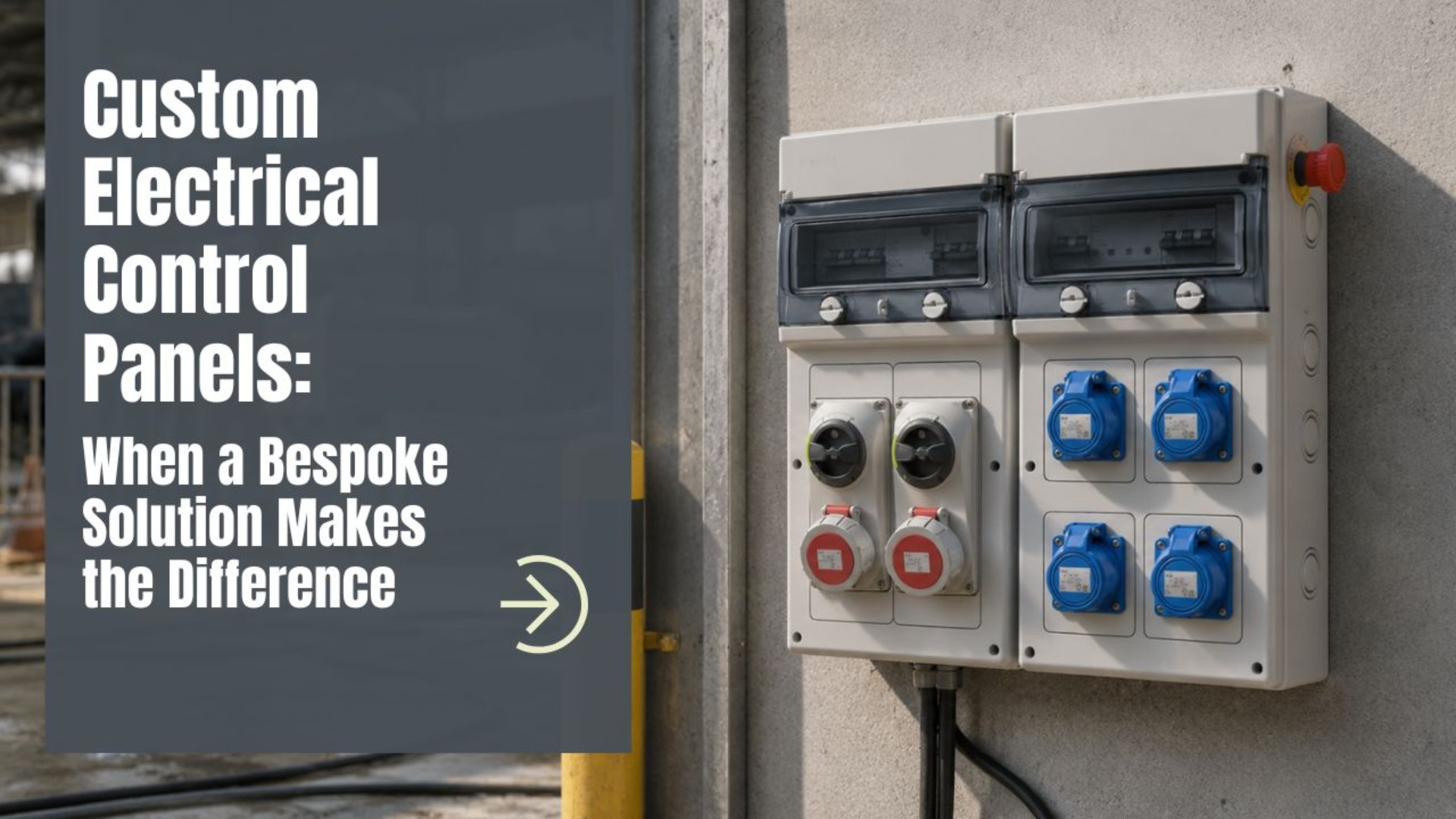
A bespoke electrical control panel is a project-specific solution designed to match the exact technical, environmental and functional requirements of an installation when a standard panel is not sufficient. In many cases, a custom-built approach improves integration, protection, maintenance access and long-term performance in ways that an off-the-shelf panel simply cannot.
Standard solutions remain useful for many straightforward installations. However, not every project fits comfortably into a standard enclosure, a fixed internal layout or a conventional protection arrangement. When space is limited, the environment is demanding, the distribution is unusual or the installation needs to work alongside other systems, a bespoke electrical control panel solution often becomes the more practical and technically coherent option.
This article is not a service page in disguise. It is a technical-commercial guide intended to help decision-making. Its purpose is to explain what a bespoke panel solution actually means, when a standard panel is not enough, what can be customised, which technical factors shape a custom project, and where custom electrical control panels add real value.
Within Solera’s English site, this topic connects naturally with the page on custom-made electrical panel assemblies, the catalogue of electrical enclosures, and technical articles such as IP protection in electrical installations and outdoor electrical enclosure selection.

What is a bespoke electrical control panel solution?
A bespoke electrical control panel solution is not simply a panel with a different label or a slightly modified layout. It is a control and protection assembly designed around the actual needs of a project, rather than around a generic starting format.
That means the panel is defined by the installation itself: the operating conditions, the protection needs, the available space, the internal distribution logic, the future maintenance requirements and the way the assembly must integrate with the rest of the system. In practice, the value of a bespoke panel lies in technical customisation, not in cosmetic variation.
This is especially important in UK projects where site conditions, enclosure selection, IP requirements, internal component arrangement or interface needs can vary significantly from one application to another. In that context, a bespoke solution is not about making something “special” for the sake of it. It is about making it fit properly.
When a standard panel is not enough
A standard electrical control panel is not enough when the installation has requirements that fall outside the assumptions built into standard products. That usually happens when the project has technical, spatial, environmental or functional conditions that need a more tailored response.
Typical situations include:
- Unusual space requirements, where the panel must fit into a defined footprint, recess or service area.
- Specific protection needs, where the arrangement of devices differs from typical board layouts.
- Non-standard internal layouts, especially where multiple functions must coexist in the same assembly.
- Environmental constraints, such as dust, humidity, external exposure or demanding technical conditions.
- Integration with other systems, including control, automation, auxiliary services or energy systems.
- Demanding industrial or technical applications, where a generic panel format may compromise usability or future maintenance.
In these cases, forcing a standard solution can create avoidable problems: cramped cable management, poor access, limited expandability, unsuitable protection levels or a panel that works only “well enough” on paper. A bespoke approach helps avoid that mismatch.
What can be customised in an electrical control panel project?
One of the strengths of custom electrical control panels is that multiple parts of the assembly can be adapted, not just the outer dimensions. This is what makes a bespoke solution technically meaningful.
Elements that can typically be customised include:
- The enclosure type, depending on indoor, outdoor, technical or industrial use.
- The internal layout, so that protection, control and distribution are arranged according to the project logic.
- The number and type of protective devices, based on circuit structure and operating requirements.
- Cable entries and outputs, depending on routing, access and installation conditions.
- Materials, especially where exposure, robustness or environmental compatibility matter.
- Suitability for indoor or outdoor use, including the protection level required.
- Project-specific configuration, particularly when the panel must work as part of a larger technical system.
That customisation may be based on a compact weatherproof enclosure, a larger thermoplastic cabinet or a more demanding industrial format. Solera’s enclosures catalogue is relevant here because enclosure choice often becomes one of the first defining decisions in a bespoke control panel project.
Standard, pre-assembled or bespoke: what is the difference?
Not all panel solutions require the same degree of adaptation. In practice, it helps to distinguish between a standard panel, a pre-assembled panel and a bespoke electrical control panel.
| Solution type | Level of customisation | Strengths | Limitations | Best fit |
|---|---|---|---|---|
| Standard | Low | Fast availability, simplicity, repeatability | Limited flexibility when project conditions are not typical | Routine installations with common requirements |
| Pre-assembled | Medium | Time saving, organised delivery, partially optimised setup | May still fall short in non-standard layouts or difficult environments | Projects with known patterns and moderate variation |
| Bespoke | High | Project fit, technical flexibility, better integration | Requires clearer analysis and definition at the design stage | Special projects, technical environments, demanding installations |
A standard panel works well when the installation is straightforward. A pre-assembled panel may be sufficient when the application is well defined and repeated often enough to justify a partially prepared solution. A bespoke electrical control panel makes more sense when the project has constraints that cannot be resolved properly with a ready-made format.
This is where the language of electrical control panels, custom electrical control panels and bespoke electrical control panels becomes commercially relevant. The difference is not marketing language. It reflects a real difference in project fit.
Technical factors to assess before designing a custom solution
A bespoke panel project should begin with technical assessment, not with enclosure selection alone. The quality of the final solution depends heavily on what is analysed upfront.
| Factor | Why it matters | Effect on design | Practical example |
|---|---|---|---|
| Installation environment | It determines exposure, material suitability and protection level | Influences enclosure type, sealing and robustness | Outdoor technical area with moisture and dust |
| Available space | It limits panel footprint and accessibility | Affects enclosure format and internal arrangement | Restricted service void or compact plant room |
| Power distribution | It defines the number and arrangement of circuits | Shapes internal protection and layout logic | Separate control, power and auxiliary sections |
| Future expansion | It avoids a design that becomes restrictive too quickly | Requires spare capacity and layout planning | Installation expected to grow in phases |
| Maintenance access | It affects usability and long-term serviceability | Influences access routes, door configuration and spacing | Technical room with regular inspection needs |
Additional factors can include IP protection level, environmental exposure, accessibility of incoming and outgoing cables, operational sequence, integration with control systems and the relationship between the panel and the wider project.
This is why technical articles such as IP protection in electrical installations and outdoor electrical enclosure selection are highly relevant in bespoke projects. The enclosure is not a neutral shell. It directly affects the viability of the design.

Advantages of bespoke electrical control panels
The main advantage of a bespoke electrical control panel is that it responds to the project as it really is, rather than forcing the project to adapt to a standard format. That usually creates value in several technical ways.
- Better project fit, because the solution is based on actual requirements rather than assumed ones.
- Improved space optimisation, especially where installation space is restricted.
- Easier integration, both physically and functionally, with the wider installation.
- More appropriate protection, matched to the real environment and use case.
- Better long-term functionality, thanks to improved accessibility and layout planning.
- Flexibility for non-standard applications, where standard formats struggle to perform well.
This is where the commercial value of a bespoke solution appears, but it remains grounded in engineering logic. The benefit is not “customisation for its own sake”. The benefit is a panel that works better in the project it was designed for.
Where bespoke electrical panel solutions add the most value
Bespoke electrical solutions add the most value where technical conditions are less predictable or more demanding than usual. That includes many project types where standard panels still appear attractive at first glance, but prove limiting once real conditions are considered.
Typical examples include:
- Industrial installations, where process demands, control needs and environmental factors often require special layouts.
- Commercial and tertiary environments, especially where technical services, controls or plant integration are involved.
- Outdoor applications, where enclosure protection, IP rating and environmental exposure become central.
- Technical rooms, where layout, access and serviceability need more thought than a standard board allows.
- Photovoltaic or energy-related projects, as one example among others, when control and protection need to fit a specific technical arrangement.
- Projects with unusual operational or protection requirements, where a standard product range does not map well onto the installation.
In that sense, a bespoke panel is often most valuable not in “average” projects, but in those where average assumptions no longer hold.

Common mistakes when trying to solve special projects with standard solutions
One of the most common mistakes in special projects is assuming that a standard solution is acceptable because it is available, familiar or apparently close enough. That can lead to problems later.
Typical mistakes include:
- Forcing a standard enclosure into a non-standard application, even when access or layout is compromised.
- Underestimating space requirements, especially for cable management and maintenance.
- Failing to plan for future expansion, which can make the installation inflexible very quickly.
- Not adapting protection to the environment, especially in humid, outdoor or technically demanding areas.
- Poor accessibility for maintenance, which may not appear critical until servicing becomes necessary.
- Choosing based on availability instead of suitability, which often shifts the problem from purchase stage to operational stage.
These are not unusual mistakes. They are exactly the kinds of design compromises that a bespoke approach helps avoid.
How to approach a bespoke electrical control panel project properly
The right way to approach a bespoke electrical control panel project is methodical. The process should begin with the application, not with the product reference.
A sound sequence usually looks like this:
- Assess the application and define what the panel actually has to do.
- Define the environment, including exposure, access, conditions and constraints.
- Identify protection and functional needs, rather than assuming a standard arrangement.
- Plan layout and expandability so that the solution remains usable over time.
- Align the panel with the real use case, including maintenance, integration and future change.
This approach is not about making the project more complicated. It is about reducing unnecessary compromise. Solera’s page on custom-made electrical panel assemblies fits naturally within that logic, because it supports the idea of tailored assemblies for projects that cannot be resolved efficiently with a standard panel alone.
Frequently asked questions about custom electrical control panels
What is a bespoke electrical control panel?
A bespoke electrical control panel is a project-specific solution designed around the exact technical, environmental and functional requirements of an installation when a standard panel is not sufficient.
When should you choose a custom electrical control panel?
You should consider it when the project has unusual space constraints, specific protection needs, non-standard layouts, difficult environments or integration requirements that a standard panel cannot address well.
What is the difference between a standard panel and a bespoke one?
A standard panel follows a predefined format. A bespoke panel is designed for a specific project, with customised enclosure selection, layout, protection and functional arrangement.
What factors should be assessed before designing a tailored panel solution?
The main factors include environment, space, protection level, distribution needs, future expansion, maintenance access and integration with the wider installation.
What are the main advantages of a custom-built panel?
Better project fit, improved space use, more suitable protection, easier integration and stronger long-term usability are among the main advantages.
Which projects benefit most from a bespoke panel solution?
Industrial, technical, commercial and outdoor projects with specific operational, environmental or protection requirements benefit most from a bespoke approach.
Conclusion
Custom electrical control panels are most valuable when the project demands more than a standard board can realistically provide. That is the point where a bespoke electrical control panel stops being an optional extra and becomes the most technically sensible route.
The key is to keep the focus on project fit. A bespoke solution is not simply a more complex version of a standard product. It is a control panel assembly designed to match real operating conditions, real protection needs and real installation constraints. For further context, it makes sense to connect this topic with Solera’s page on custom-made electrical panel assemblies, the enclosures catalogue, and practical technical articles such as IP protection and outdoor enclosure selection, all of which reinforce the same project-driven approach.