

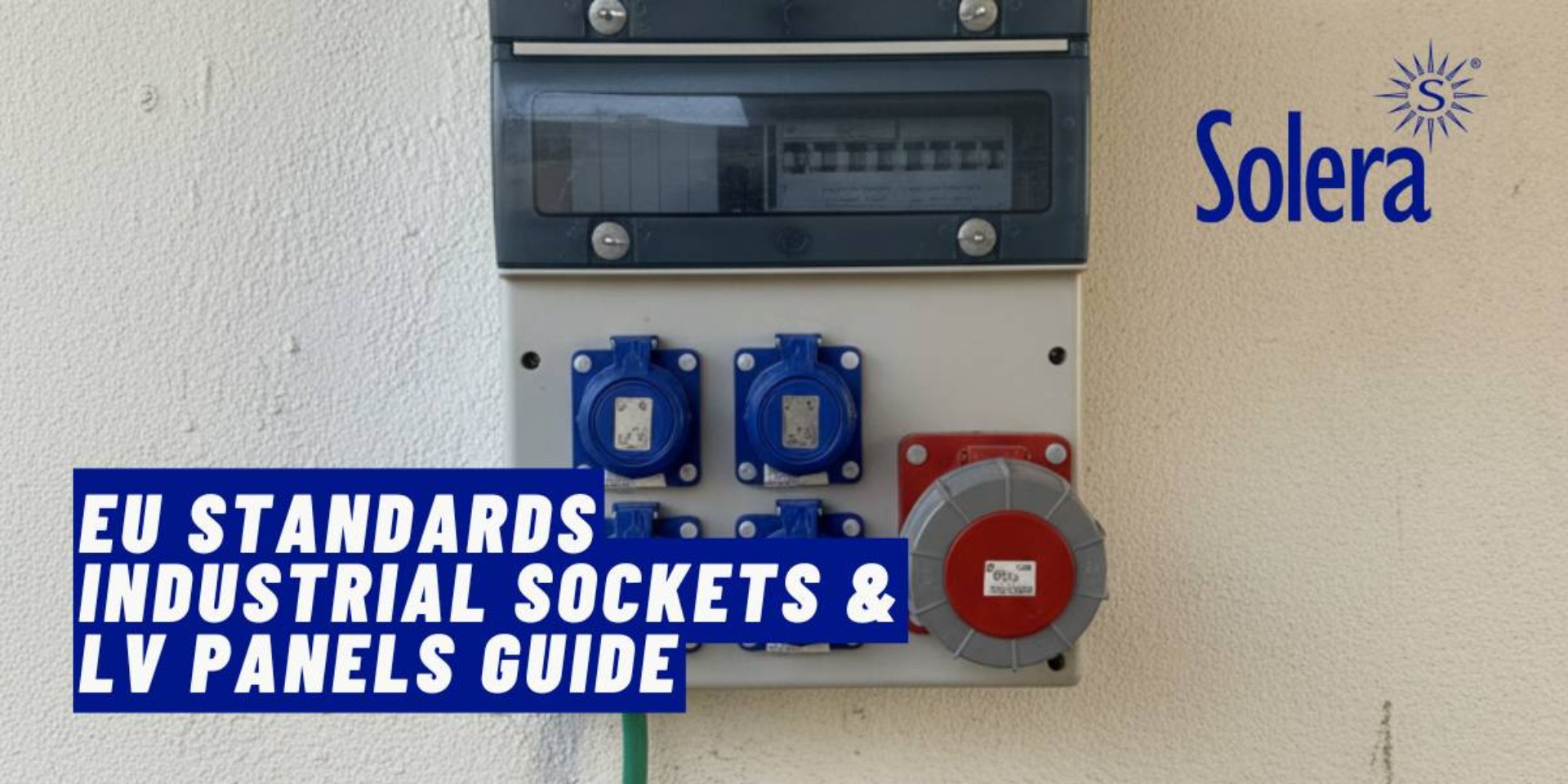
If you work with industrial plugs and sockets and low-voltage assemblies, the UK regulatory framework is not a formality. It underpins safe design, reduces incidents, and supports clean documentation. This guide sets out what the standards require, why each point matters, and how to implement it with Solera solutions.
1) The framework that ties everything together
In Great Britain, electrical equipment within 50–1,000 V AC or 75–1,500 V DC is governed by the Electrical Equipment (Safety) Regulations 2016. Conformity is demonstrated through BS EN standards, technical documentation, and appropriate marking (UKCA or CE, as applicable). Consistency between design, verification, and documentation prevents future failures and rework.
Four standards fit together like a puzzle: BS EN 60309 for industrial plugs and sockets, BS EN 61439 for assemblies, BS EN 60529 for IP, and BS EN 62262 for IK. Your technical file connects these pieces and traces every engineering decision.

2) Industrial plugs and sockets (BS EN 60309): real compatibility, impossible errors
The BS EN 60309 family standardises what matters: dimensions, clock-position keying, colour, and performance. The goal is critical and simple. Two compatible devices must always mate. Two incompatible systems must never connect.
Daily use turns this into clear choices. For single-phase 230 V services, blue 6h is typical at 16–32 A. For three-phase 400 V, red 6h dominates from 32–63 A. On sites using reduced voltage, yellow 4h avoids dangerous mix-ups. The coding is not cosmetic. It is an engineering safeguard.
Where the installation needs a wall or panel solution, industrial sockets and interlocked socket-outlets solve mounting, sealing, and maintenance. If you also need visible isolation or mechanical interlock, integrate switching or house the lot in a sealed enclosure.
Review Solera’s industrial plugs & sockets range from 16 to 125 A with IP44–IP67, built for tough work.
3) IP and IK: protection is designed, not improvised
IP (BS EN 60529) defines protection against dust and water. IK (BS EN 62262) measures impact resistance. The right pairing avoids fluid ingress, mechanical damage, and early failures. Indoors, IP44 often suffices. For harsher settings, specify IP65–IP67.
Indubox enclosures with IP65 provide raised protection against dust and water jets. For a deeper dive into levels and tests, see our guide on IP protection with practical examples.
4) Low-voltage assemblies (BS EN 61439): the whole, not the parts
BS EN 61439 assesses the complete assembly, not isolated devices. It distinguishes design verification (tests and calculations that validate the concept) from routine verification (checks on every built assembly).
For power distribution attended by skilled personnel, use Part 2. For residential and commercial boards, Part 3 (DBO) protects the non-technical user. Part 7 addresses special locations such as marinas, campsites, or EV infrastructure. Designing to this logic reduces rework and avoids field non-conformities.
For harsh environments, Indubox industrial and site boards combine IP65, high mechanical strength, and a broad family of accessories. If the project needs something specific, our custom assemblies team integrates protections, sockets, signalling, and other devices into a compliant build.
5) How to define the design: decisions that matter
Analyse the environment. Fine dust, water, UV, chemicals, or saline air determine IP, IK, and which devices to include. Then define service characteristics: rated voltage, simultaneity, switching cycles, and future expansion. Next, select protections (main switch, MCBs, RCDs, and surge protection where required by BS 7671), thermal dissipation, interlocked outlets if needed, signalling, and a maintenance plan.
At socket outlets, match conductor size and terminal torque. Inside the assembly, evaluate internal separation, conductor routing, and risks of overheating or arcing. Make verification of key points routine: earth continuity, dielectric strength, and functional checks. This sequence yields safe assemblies that are easy to service.
6) Three scenarios and how to solve them
6.1 Indoor workshop with variable loads
Single-phase 230 V with occasional peaks. A blue 6h 16–32 A outlet with IP44 handles splashes. The board can be DBO if operated by non-skilled users. Add clear labelling and leave spare space for future circuits.
6.2 Outdoors with dust and water jets
Specify IP65–IP67 and a high IK rating. Install outlets and protections in an Indubox enclosure. Re-check sealing after maintenance and use cable glands for entries. Record critical closure points and tightening torques in the documentation.
6.3 Construction sites and events
Prioritise robustness and mobility. A portable board with RCD + MCB, emergency stop, and red 32–63 A outlets avoids improvisation. Label voltages and split circuits by zone. A pre-use inspection routine cuts in-service incidents.
7) Visual summary
This table condenses common combinations. Use it as a quick guide and always validate against the real service conditions.
| Environment | Indicative IP/IK | BS EN 60309 outlet | BS EN 61439 assembly |
|---|---|---|---|
| Dry interior | IP44 / IK07–IK08 | Blue 6h, 16–32 A | DBO, space reserved |
| Demanding exterior | IP65–IP67 / IK08–IK10 | Red 6h, 32–63 A, reinforced seals | Indubox with drainage |
| Construction sites and events | IP65 / IK09–IK10 | Red 6h, 32–63 A; yellow 110–120 V where applicable | Portable board with RCD + MCB and E-stop |
8) Repeated mistakes and how to avoid them
The most common failure is under-specifying the environment. Choosing insufficient IP exposes the system to dust and water. Another classic is incorrect terminal torque, which damages terminals and raises temperatures. Lack of interlocking during on-load operations also causes incidents. Document torque values, define re-tightening routines, and mark critical points. Service life increases markedly.

9) Documentation is part of the design
Documentation is not an afterthought. The assembly nameplate should state electrical data, IP/IK, and traceability. Diagrams and the bill of materials must be version-controlled. Verification protocols retain design and routine results. The UK declaration cites applied standards. Build a realistic maintenance plan so every future intervention follows a clear protocol.
10) Pre-handover checklist
Before sign-off, review three blocks: applicable standards (BS EN 60309, BS EN 61439, BS EN 60529, BS EN 62262), verifications (design and routine complete), and marking/documentation up to date. Add a field sealing check in aggressive environments and a functional test with representative load.
11) Solera resources to speed up your work
If you need a robust starting point, Indubox enclosures deliver IP65 with a wide set of formats. Industrial sockets cover 16–125 A at IP44–IP67. For panel applications, interlocked outlets simplify installation and safety. For a turnkey build, our custom assemblies team delivers boards with documentation and tests.
To reinforce sealing concepts, see IP in installations and this overview of enclosures for board building.
Want to specify a board with confidence or standardise your outlets? Explore enclosures, industrial sockets, and request a bespoke assembly with audit-ready documentation.