

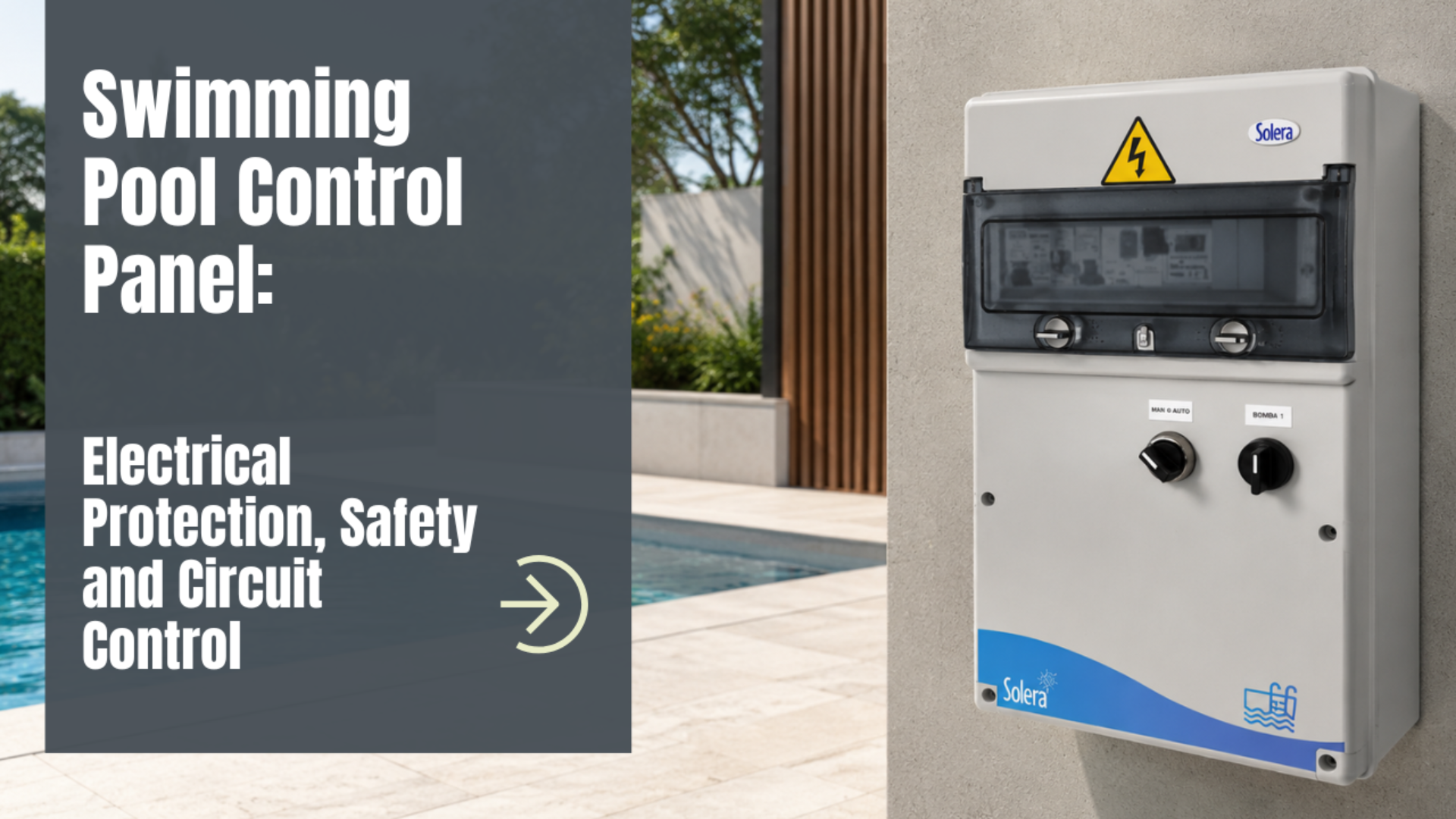
A swimming pool control panel centralises the electrical protection and control of the circuits associated with a pool installation. It can help organise and protect circuits for equipment such as pumps, lighting or auxiliary systems, while using an enclosure and protection devices suited to humid, technical or outdoor environments.
In pool installations, electrical safety must be considered from the beginning. Water, humidity, possible splashes, outdoor exposure and motorised loads create a more demanding environment than a standard indoor electrical installation. For that reason, the panel should not be chosen only as a box to house devices, but as a complete electrical protection and control point.
This article focuses on the electrical side of the installation: pool electrical protection, circuit organisation, RCD and MCB protection, IP-rated enclosures, indoor or outdoor location, maintenance access and the advantages of using a dedicated pool protection panel. It does not focus on pool pumps, filters or swimming pool maintenance. Pumps, filtration and lighting are mentioned only as circuits or equipment that the panel may protect or control.
Within Solera’s range, this topic connects naturally with swimming pool protection panels, the broader Indubox enclosure range, technical guidance on IP protection in electrical installations and the article on electrical safety in wet environments.
What is a swimming pool control panel?
A swimming pool control panel is an electrical control and protection unit designed to organise the circuits associated with a pool installation. It may protect or control circuits for the pool pump, filtration-related equipment, lighting or auxiliary systems, depending on the configuration.
Unlike a generic pool electrical box, a dedicated pool control panel is designed around a more specific use case. It is not only an enclosure. It is a structured point where protection devices, control elements and outgoing circuits can be arranged in a safer and clearer way.
This distinction matters because pool environments are often affected by humidity, water proximity, outdoor conditions and maintenance requirements. Choosing the right control panel helps reduce improvisation and creates a more organised electrical installation.
For a broader understanding of how electrical panels are organised, Solera’s guide to the home electrical panel can help explain the general role of protective devices and circuit organisation in an installation.
Why electrical protection is important around swimming pools
Electrical protection for swimming pools is important because the installation operates near water, humidity and often outdoor exposure. These conditions make the correct selection of protective devices and enclosures especially relevant.
The main reasons to use a suitable control and protection panel include:
- presence of water and humidity, which increases the need for careful enclosure and protection selection;
- outdoor or semi-outdoor installation, where dust, rain, temperature changes and sunlight may affect the enclosure;
- need for suitable protection devices, including RCD and MCB protection where required by the design;
- clear circuit organisation, especially when pump, lighting and auxiliary circuits are present;
- avoidance of improvised electrical solutions, which can complicate maintenance and reduce safety;
- easier inspection and maintenance, because devices are grouped in a logical and accessible panel.
This is why choosing a dedicated pool electrical protection panel can make sense when the installation requires organised circuit protection inside a suitable enclosure.
What can a pool control panel protect or control?
A pool control panel can protect and control several circuits associated with the pool installation. The equipment itself is not the focus; the important point is how the electrical circuits are organised and protected.
Typical circuits or functions may include:
- pool pump circuit, treated as an electrical load requiring suitable protection;
- filtration-related circuit, especially when timed operation is required;
- pool lighting circuit, which should be considered separately from other loads;
- auxiliary circuits, depending on the installation requirements;
- timed operation, when a programmer or time switch is integrated;
- general circuit protection, through suitable protective devices inside the panel.
This centralisation helps keep the electrical installation clearer. Instead of treating each function as a separate addition, the panel provides a structured point for control, protection and maintenance.
Typical components in a swimming pool control panel
A swimming pool electrical control panel can include several protection and control components. The exact configuration depends on the installation, the circuits to be supplied and the environment where the panel will be located.
| Component | Function | What it protects or controls | When it is useful |
|---|---|---|---|
| MCB | Protection against overloads and short circuits | Electrical circuits and connected loads | For general or dedicated circuit protection |
| RCD | Protection against earth leakage faults | People and the installation in leakage fault conditions | Especially relevant in environments linked to water and humidity |
| Contactor | Electrical switching of loads | Controlled circuits or equipment | When automatic or indirect control is required |
| Timer / programmer | Timed operation control | Circuits that operate in scheduled periods | When automatic operating cycles are needed |
| Motor protection | Specific protection for motorised loads | Pool pump circuit or similar motorised equipment | When the installation includes a motor requiring dedicated protection |
| Lighting circuit protection | Protection of lighting circuits | Pool lighting or surrounding lighting circuits | When the panel supplies or controls lighting |
| IP-rated enclosure | Physical protection of the assembly | Internal components against dust, moisture or water exposure | Essential in humid, outdoor or technical pool environments |
These elements should not be selected in isolation. A good pool control panel combines protective devices, control elements and an enclosure that suits the environment. Solera’s protection devices and Indubox IP65 distribution boxes are useful references when considering how electrical protection and enclosure selection work together.
RCD and MCB protection: what role do they play?
RCD and MCB protection perform different functions in an electrical installation. Both may be relevant in a pool control panel, but they do not protect against the same type of risk.
An MCB protects circuits against overloads and short circuits. It is related to overcurrent protection and helps protect cables and connected circuits when current exceeds safe levels.
An RCD protects against earth leakage faults. Its role is different: it detects leakage current and disconnects the circuit when the fault condition reaches the device threshold.
In simple terms:
- an MCB protects against overcurrent;
- an RCD protects against earth leakage;
- both devices address different risks;
- correct selection must be carried out by a qualified professional.
This is especially important in pool-related installations, where electrical protection must be considered carefully because of the surrounding environment. If you need more general context on electrical faults, Solera’s article on short circuits explains why moisture and poorly sealed installations can be problematic in electrical systems.
IP-rated enclosures for pool environments
An IP-rated enclosure is essential in pool environments because it helps protect the electrical components inside the panel from dust, moisture and water ingress. The IP rating should always be matched to the real installation conditions.
The IP rating indicates the level of protection provided by an enclosure against solid objects and liquids. Around a pool, this matters because the control panel may be installed in a technical room, under partial cover, in an outdoor area or in a humid space.
When selecting the enclosure, it is important to consider:
- indoor or outdoor location;
- level of humidity;
- possible exposure to splashes or water;
- dust, garden or outdoor conditions;
- maintenance access;
- long-term protection of internal devices.
Solera’s guide to IP protection in electrical installations explains how IP ratings work and why they are important. For installations exposed to external conditions, the article on outdoor electrical enclosures is also relevant.
If the installation needs a robust enclosure family for technical or outdoor electrical applications, the Indubox range offers solutions designed for distribution and protection needs, including dedicated Indubox pool protection panels.
Pool lighting and auxiliary circuits: why separation matters
Pool lighting circuits and auxiliary circuits should be organised clearly inside the control panel. Circuit separation helps make the installation easier to understand, inspect and maintain.
This is not about turning the article into a guide on lighting products. The focus is electrical organisation. When lighting, pump and auxiliary circuits are grouped without a clear logic, maintenance becomes more difficult and the risk of confusion increases.
Good circuit organisation can help:
- separate lighting from pump-related circuits;
- improve clarity inside the panel;
- make inspection easier for the professional;
- allow individual protection where required;
- leave space for future changes or additions;
- avoid improvised or unclear wiring layouts.
For wider technical context, Solera’s article on electrical safety in wet environments is directly relevant, because it explains why installations in humid or water-related locations require particular care.
Swimming pool control panel diagram: what should be considered?
A swimming pool control panel diagram should be understood as a functional overview of the main protection and control blocks, not as a step-by-step wiring guide. Detailed design and wiring must always be carried out by a qualified electrician.
At a general level, a pool control panel diagram may consider:
- supply to the panel;
- main protection;
- RCD protection;
- outgoing circuits for the associated electrical loads;
- timed control, if a timer or programmer is required;
- lighting circuit, if lighting is included;
- suitable enclosure, selected according to the environment.
This section helps address the technical intent behind searches for pool control panel diagrams without providing connection instructions. In real installations, circuit design, device selection, verification and final wiring should be handled by qualified professionals and aligned with the applicable requirements.
How to choose a swimming pool control panel
Choosing a swimming pool control panel means assessing the environment, the circuits to be controlled, the protection required and the suitability of the enclosure. The decision should not be based only on size or price.
| Criterion | Why it matters | Practical recommendation |
|---|---|---|
| Location | It determines whether the panel is protected, exposed, indoor or outdoor | Assess the real installation environment before choosing the enclosure |
| IP rating | It helps protect against dust, moisture and water ingress | Match the IP rating to the level of exposure |
| Number of circuits | It affects internal space and organisation | Plan current circuits and possible future additions |
| Type of loads | Different loads may require different protection or control | Consider motorised, lighting and auxiliary circuits separately |
| Lighting | Lighting may require dedicated circuit organisation | Plan lighting circuits clearly from the beginning |
| Maintenance | The panel should be easy to inspect and service | Choose a clear, accessible and well-organised solution |
| Future expansion | Additional circuits may be needed later | Leave space for future needs where appropriate |
For projects that require a compact and purpose-designed electrical solution, swimming pool protection panels can centralise protection and control for circuits associated with the pool in one organised assembly.
Common mistakes when choosing a pool electrical control panel
The most common mistakes come from treating a pool installation like a standard indoor installation or choosing a generic box without considering the actual environment.
- Using an unsuitable enclosure, especially in humid or outdoor locations.
- Ignoring the IP rating, even though the panel may be exposed to moisture or dust.
- Not planning circuit separation, making maintenance and inspection more difficult.
- Choosing only by price, without assessing protection, enclosure quality or long-term access.
- Leaving no space for future needs, which limits future additions or modifications.
- Using a generic box where a dedicated panel is more appropriate.
- Treating pool electrical circuits as a standard indoor installation, despite the more demanding environment.
These mistakes can make the installation harder to maintain and less coherent. In many cases, using a dedicated pool protection panel is a more practical way to organise electrical protection from the start.
When to choose a pre-assembled pool protection panel
A pre-assembled pool protection panel is useful when the installation requires a dedicated, organised and safer electrical solution for pool-related circuits. Its main advantage is that it brings protection, control and enclosure suitability together in a single assembly.
This type of solution makes sense when:
- several electrical circuits are associated with the pool installation;
- lighting or auxiliary circuits need to be controlled or protected;
- timed operation is required;
- the panel will be installed in a humid, technical or outdoor environment;
- clear maintenance access is important;
- the installer wants to avoid improvised assemblies.
Solera’s Indubox pool protection and management panels are designed for this type of application. They help centralise electrical protection and control in a range intended for pool-related circuits.
Specific examples, such as the 1311A-PS5 swimming pool control panel, the 1311P-PS3 swimming pool control panel and the CSP-06 pool control panel, show how a dedicated panel can combine enclosure protection, circuit organisation and electrical control functions in one solution.
Frequently asked questions about swimming pool control panels
What is a swimming pool control panel?
A swimming pool control panel is an electrical panel designed to organise, protect and control circuits associated with a pool installation, such as lighting, pump-related circuits or auxiliary loads.
What does a pool control panel protect?
It can protect and organise circuits connected to the pool installation, including lighting, motorised loads and auxiliary equipment, depending on the configuration.
Why is IP rating important for a pool control panel?
IP rating is important because the panel may be installed in a humid, dusty, outdoor or water-related environment. The enclosure must protect internal devices against the real exposure conditions.
What is the difference between a pool electrical box and a pool control panel?
A pool electrical box may simply house components, while a pool control panel is usually organised to provide electrical protection, circuit control and clearer maintenance access.
Can a swimming pool control panel manage lighting circuits?
Yes, if it is designed for that purpose. Lighting circuits should be planned clearly and protected according to the installation requirements.
What role do RCDs and MCBs play in pool electrical protection?
An MCB protects against overloads and short circuits, while an RCD protects against earth leakage faults. They perform different protection functions and should be selected by a qualified professional.
When should you use a pre-assembled pool protection panel?
It is useful when the installation needs a dedicated and organised solution for circuit protection, control, enclosure suitability and easier maintenance.
Conclusion
A swimming pool control panel should be selected as part of the electrical protection strategy for the installation, not as a generic box. The key factors are circuit organisation, RCD and MCB protection, IP rating, indoor or outdoor location, maintenance access and enclosure suitability.
The pump, filtration or lighting may be present as electrical loads, but they should not define the whole article or the whole choice. The main priority is a safe and organised electrical solution for a humid or outdoor-related environment.
For installations where a dedicated solution is preferred, Solera’s swimming pool protection panels provide a clear route towards organised electrical protection and circuit control. To complete the selection, it is also useful to review the Indubox range, the guide to IP protection, the article on electrical safety in wet environments, the resource on outdoor electrical enclosures and Solera’s electrical protection devices.