

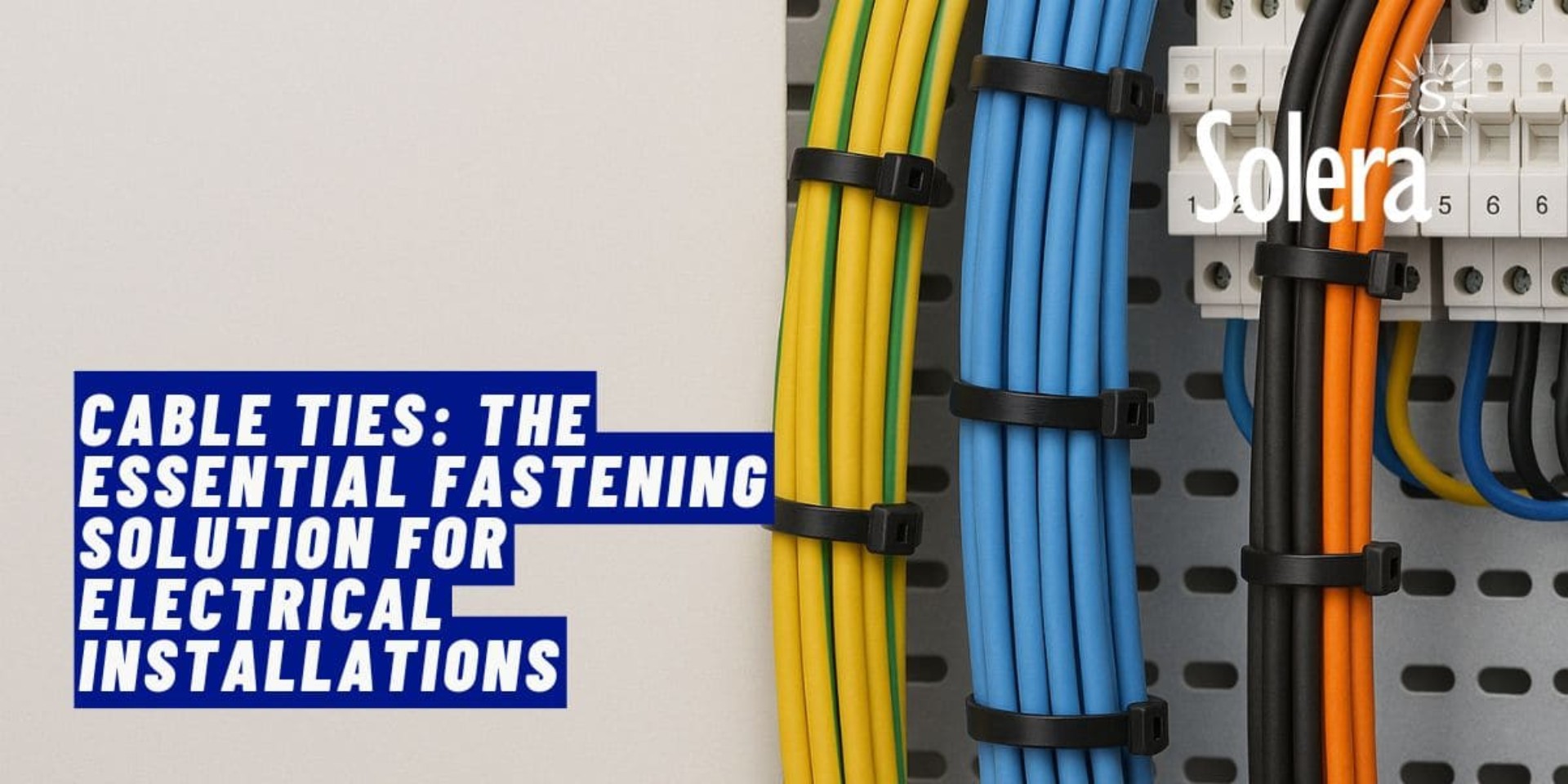
Cable ties, also commonly known as “zip ties,” are simple yet indispensable components in both professional electrical installations and everyday cable management. These handy fasteners consist of a flexible nylon strip with an integrated locking mechanism, allowing users to bundle and secure cables with ease. Electricians and installers rely on cable ties for keeping wiring organized, safe, and compliant with standards, while home users appreciate their convenience for tidying up cords.
In this comprehensive guide, we’ll explore what cable ties are, the various types available (from standard nylon ties to reusable, heat-resistant, and stainless steel options), best practices for using them in electrical work, comparisons with alternative fastening methods, and more. The goal is to shed light on why cable ties are such a crucial part of cable management and how to use them effectively.
A standard nylon cable tie (natural color) used for bundling cables. The tail end is pulled through the locking head, creating a secure loop. Cable ties come in many sizes and types but share the same basic mechanism for quick and reliable fastening.
Introduction: The Role of Cable Ties in Electrical Installations
Cable ties have a vital role in electrical installations and cable management systems. At their core, cable ties are fastening tools that allow for quick, efficient grouping of cables, wires, or hoses into neat bundles. In an electrical panel or a network rack, for example, using ties to organize wiring not only improves the appearance but also enhances safety.
Neatly tied cables reduce the risk of accidental damage, tripping hazards, or short circuits by preventing wires from snagging or tangling. In residential settings, cable ties help keep power cords and electronic cables out of the way, contributing to a safer and more organized environment. In industrial and commercial installations, they ensure that complex wiring systems remain orderly, making maintenance easier and reducing wear on cables from vibration or movement.
Beyond organization, cable ties support compliance with electrical standards and best practices. Many building and electrical codes require that wiring is secured at regular intervals; cable ties provide a quick solution to meet these requirements.
They are often made of durable nylon (polyamide) which offers excellent tensile strength and insulation, ensuring that bundles stay tightly fastened without conducting electricity. Whether you are fastening harnesses inside an electrical cabinet, routing network cables in a data center, or simply tidying the cords behind your entertainment center, cable ties prove to be an essential, low-cost tool that significantly improves cable management and overall safety.
Different Types of Cable Ties
Not all cable ties are the same. There are several types designed to meet different requirements, environments, and preferences. Below we explain the most common types of cable ties and their uses:
| Type | Main Features | Typical Applications |
|---|---|---|
| Nylon Cable Ties | High tensile strength, flame retardant, resistant to aging. | General electrical installations, cable management, panels. |
| Releasable Cable Ties | Can be reused; equipped with a release mechanism. | Temporary installations, prototyping, reusable harnesses. |
| Stainless Steel Cable Ties | Extreme temperature resistance, corrosion-proof. | Industrial settings, marine environments, heavy-duty cabling. |
| UV-Resistant Cable Ties | Formulated to withstand prolonged sun exposure. | Outdoor solar panels, street lighting, external cabling. |
| Colored Cable Ties | Help in identifying circuits or cable groups easily. | Data centers, telecom installations, visual troubleshooting. |
Standard Nylon Cable Ties
Standard nylon cable ties are the most ubiquitous type. They are typically made from Nylon 6.6 (polyamide), a material known for its strength, flexibility, and resistance to wear. These ties are single-use self-locking straps: once you insert the tail through the head and pull it tight, it locks in place and generally needs to be cut to be removed. Standard nylon ties come in a wide range of sizes and colors. For example, Solera’s nylon cable ties are available in widths from about 2.5 mm up to 8.8 mm, and lengths from roughly 100 mm (4 inches) to 500 mm (20 inches), accommodating everything from small electronics cables to large bundles of industrial wires.
Common color options include natural (milky white), black, gray, brown, and green, which can be useful for color-coding or matching the environment. Standard nylon ties are valued for their high tensile strength and durability – despite their lightweight design, they can securely hold cable bundles together (small ties might support around 8–10 kg of tensile force, while larger ones handle much more). These ties are ideal for general purpose use in homes, offices, and industrial settings, and they perform well in temperatures ranging approximately from -40°C to 85°C, which covers most indoor and moderate outdoor environments.
An important variant of the standard nylon tie is the UV-resistant cable tie. These are typically black nylon ties manufactured with UV-stabilized materials (like carbon black added to the nylon) to withstand prolonged exposure to sunlight without becoming brittle. UV-resistant ties are recommended for outdoor use (for example, securing cables on rooftops, antenna masts, or solar panel installations) because standard light-colored ties may degrade over time under harsh sun. When using cable ties outdoors or in high-heat areas, look for those labeled as UV-resistant or heat-stabilized to ensure longevity.
Reusable & Releasable Cable Ties
While most cable ties are single-use, there are reusable cable ties designed with a release mechanism that allows them to be undone and reused multiple times. Releasable cable ties often have a small lever or tab in the locking head—by pressing this tab, you can loosen the tie and pull it open instead of cutting it. These ties are ideal for situations where your cable configurations may change frequently or temporarily. For instance, in stage lighting, prototyping labs, or network cable setups that get reconfigured often, reusable ties provide the benefit of adjustability and reduce waste.
Although reusable ties may not achieve the same ultimate tensile strength as standard one-time locks (due to the mechanism), they are typically robust enough for moderate bundling tasks and have the convenience of reusability. They also help environmentally by reducing the number of disposable plastic ties used.
Heat-Resistant Cable Ties
In high-temperature environments – such as automotive engine bays, near boilers, or in certain industrial machinery – heat-resistant cable ties are necessary. These ties are usually made from specially formulated nylon or other polymers that can withstand higher continuous temperatures without losing strength or melting. Standard nylon 6.6 ties are generally rated up to around 85°C, but heat-stabilized versions can often handle temperatures above 100°C (and brief exposures to even higher temperatures).
Heat-resistant ties might be colored differently (sometimes beige or green) to distinguish them, depending on the manufacturer. When securing cables in attics, near heat ducts, or around machinery that runs hot, using ties rated for high temperature ensures that your cable bundling remains secure and safe over time.
Stainless Steel Cable Ties
For the most demanding conditions, stainless steel cable ties are available. Unlike nylon ties, these are made entirely of metal (often stainless steel grades like 304 or 316). Stainless steel ties are exceptionally strong, fireproof, and resistant to chemicals, corrosion, and extreme temperatures. They are commonly used in harsh environments such as marine settings (where saltwater corrosion is a concern), oil and gas industries, aerospace, and heavy industrial installations.
For example, in shipyards or on factory equipment that experiences high heat, a stainless steel tie will remain intact long after a plastic tie would have degraded. These ties use a self-locking mechanism as well, often a ball bearing or tooth design that grips the tie as it is tightened. While stainless ties are more expensive and not as easy to work with (they usually require a special tool to tension and cut cleanly), they provide an unrivaled durability. Electricians might use metal cable ties in outdoor solar installations or where non-combustibility is important. In some cases, plastic-coated stainless steel ties are used to combine the strength of metal with a gentler surface for the cables.
Specialty Cable Ties
Apart from the above categories, there are several specialty cable ties designed for specific needs:
- Marker ties: These are cable ties that include a flat tag or label section on which you can write or affix identifying information. They are great for labeling bundles or specific cables (for instance, marking which bundle goes to which circuit or device).
- Mountable head ties: These ties have a mounting hole or an eyelet as part of the head, allowing you to screw or bolt the tied bundle to a surface. They simplify securing a cable bundle along a wall or inside a panel by combining the tie and mounting point in one piece.
- Push-mount ties: Similar in purpose to mountable ties, push-mount cable ties have a special clip or arrowhead that can be pushed into a pre-drilled hole or a slot in a panel, locking the tie (and the bundle) directly to the panel without a separate screw. These are often used in automotive applications to clip wire looms to the car’s frame or in appliances.
- Double-headed or parallel ties: These have two locking heads, allowing you to bundle two separate groups of cables with one tie, or to create a loop and then a second loop with the same tie for extra security. They’re a niche solution but can be useful in specific harnessing scenarios.
- Heavy-duty extra-wide ties: Some ties are made extra wide (for example, 12 mm or more) for heavy-duty applications. These can support very large bundles or higher weights and often have higher tensile strength ratings. Within standard nylon ties, the wider and thicker the tie, typically the stronger it is – always check the rated tensile strength if you’re securing heavy objects.
When choosing a type of cable tie, consider the environment and requirements of your project: for example, use flame-retardant or halogen-free ties in plenums or public spaces where fire safety is crucial, UV-resistant ties outdoors, and stainless steel in extreme conditions. The wide variety of cable tie types ensures that for almost any scenario – be it a temporary fix at home or a mission-critical industrial bundle – there is a suitable tie available.
Solera’s Nylon Cable Ties: Quality and Features
Solera offers a comprehensive range of nylon cable ties, with a focus on safety, reliability, and meeting industry standards. Solera’s nylon ties are UL-certified and made from high-grade Polyamide 6.6, which means they have been tested and recognized for electrical installations (compliant with standards like UL 62275 and European Norms for cable management. One key feature of Solera’s ties is that they are halogen-free – this indicates that if the ties are exposed to fire, they will not release halogen gases (like chlorine or bromine), which are toxic and corrosive.
Halogen-free cable ties are preferred in public buildings, data centers, and other sensitive environments because they contribute to lower toxicity and smoke in case of fire. In practical terms, this adds an extra layer of safety for installations in closed areas, complementing other fire-safe equipment.
Solera’s nylon cable ties come in a broad selection of sizes and colors to suit different tasks. You can find very small ties (for example, 2.5 mm width, 100 mm length) for light-duty bundling of a few small wires, all the way up to large ties (around 7.6–8.8 mm width and 450–500 mm length) for heavy-duty applications. This range allows installers to pick an optimal size – using a tie that is appropriately sized for the bundle diameter and weight ensures a secure hold. All Solera ties feature a quick-locking mechanism that grips the tie’s serrated strip firmly as you tighten it, simplifying installation and saving time. The ties are offered in natural (off-white) color as well as UV-resistant black and even other colors (gray, brown, green), which can be useful for identification or aesthetic matching.
According to Solera’s product specifications, their standard nylon ties have a working temperature range roughly from -40ºC to +85ºC, making them suitable for both cold and hot environments encountered in typical electrical and industrial installations. They also maintain good dielectric properties and material strength throughout that range.
When using Solera’s cable ties, installers can be confident in their performance and compliance. The ties carry relevant markings and certifications such as CE and UL marks, indicating adherence to European Low Voltage Directive and other regulations.
They are packaged conveniently (often in bags of 100 pieces for the small and medium sizes) for easy stocking in an electrician’s toolkit or workshop. In summary, Solera’s nylon cable ties deliver on the key factors professionals care about: strong fastening capability, safety (UL-listed, halogen-free, RoHS compliant), durability, and versatility. For more information or to see the available sizes, you can visit the Nylon Ties product page on Solera’s website, which lists all the variants and their specifications.
Best Practices for Using Cable Ties in Electrical Work
Using cable ties may seem straightforward – and it generally is – but to achieve a professional, safe installation, it’s important to follow some best practices. Here are key tips for electricians and DIY enthusiasts when applying cable ties:
- Plan Your Cable Layout: Before you start bundling wires, plan the routing of your cables. Group related cables together (for example, cables going to the same location or serving a similar purpose) so that you can tie them in a logical way. In electrical panels, keep high-voltage cables separate from low-voltage or data cables when possible to reduce interference and meet code requirements.
- Use the Correct Tie Size: Select a cable tie of appropriate length and tensile strength for the bundle. Avoid the temptation to “daisy-chain” multiple small ties for a large bundle; instead use a single larger tie which will be more secure. Each tie has a maximum bundle diameter – for instance, a small 100 mm tie might only bundle up to ~20 mm diameter of cables. Using the right size ensures a snug fit without overstressing the tie.
- Avoid Over-Tightening: When tightening a cable tie, pull it firm enough to hold the cables neatly, but not so tight that it damages the cable insulation or deforms the cables. Over-tightening can pinch electrical wires, potentially causing performance issues (especially with data cables or fiber optics) or even safety hazards if insulation is compromised. A good rule of thumb is that you should not see the cable jacket indenting under the tie. Using a proper cable tie tensioning tool can help apply consistent tension without going overboard.
- Trim the Excess Tail Safely: After securing a tie, always cut off the excess tail for a neat finish. Use a flush-cutting tool or scissors to trim the tie as close to the head as possible, and be cautious of the sharp end. A poorly trimmed tie can leave a razor-sharp edge that might cut fingers or nearby insulation. Some cable tie tools automatically cut the tail off flush once the right tension is reached, which is ideal for professional work.
- Spacing and Support: In longer cable runs, use multiple ties spaced at regular intervals rather than a single tie in the middle. For example, when running cables along a beam or through a cable tray, you might tie them every 30–50 cm (or as required by code) to provide consistent support. This prevents cables from sagging or putting too much strain on one tie. If running cables along walls or surfaces, consider using mounts or adhesive bases in conjunction with ties so that you can secure the bundle to the structure.
- Label and Differentiate: When you have many bundles or many cables, it’s wise to label them. You can use marker cable ties (with built-in tags) or simply attach a label under a tie for identification. Another method is using different colored ties to indicate different circuits or functions (for instance, using green ties for ground cables, or red ties for a particular phase or system). Proper labeling saves time when troubleshooting or modifying installations later.
- Mind Environmental Factors: Choose tie material according to the environment. Indoors in climate-controlled spaces, standard nylon ties work great. Outdoors under direct sun, use UV-resistant (usually black) ties. In a plenum space (air handling area) or sensitive environment, use ties that are low-smoke and halogen-free (so they meet fire codes for that application). If a cable run will experience movement or vibration, ensure the ties can handle it – sometimes using an extra cushioning (like wrapping the bundle in a small sleeve before tying) can protect cables from chafing under the tie in high-vibration scenarios.
By following these practices, you’ll ensure that your use of cable ties contributes to a clean, professional installation that stands the test of time.
Remember that while cable ties are incredibly useful, they should be used correctly to fully gain their benefits. Improper use (like over-tightening or using the wrong type of tie) can defeat their purpose by damaging cables or failing prematurely, so a little care goes a long way.
Cable Ties vs. Alternative Fastening Methods
Cable ties are popular, but they are not the only way to bundle or secure cables. Depending on the project, you might consider some alternative cable management and fastening methods. Here we compare cable ties with a few common alternatives:
- Velcro Straps (Hook-and-Loop Ties): Velcro cable straps are reusable fabric strips with hook-and-loop fastening. They are gentle on cables (since they are soft and don’t cinch as tightly as nylon ties) and can be reopened and adjusted easily. This makes them excellent for scenarios like network cabling or AV equipment, where you may re-route or add/remove cables frequently. Compared to nylon zip ties, Velcro straps have lower tensile strength and can’t bear as much weight, so they’re not ideal for heavy bundles or critical permanent support. However, they avoid the issue of over-tightening (you can only pull them so tight) and leave no sharp edges. Many data centers prefer hook-and-loop ties for patch cords to avoid crushing insulation. In contrast, nylon cable ties provide a more compact, secure hold for permanent installations and typically cost less per piece than Velcro straps. In practice, both can be used complementarily: for example, using zip ties for the permanent trunk runs and Velcro for the adjustable parts of a cabling system.
- Electrical Tape: Bundling cables with electrical tape is another method sometimes used, especially in quick fixes. While tape can hold a bundle together, it is generally inferior to cable ties for several reasons. Over time, tape adhesive can degrade with heat and dust, causing the bundle to unravel. Tape can also become messy – the sticky residue it leaves behind is troublesome if you need to rework the cables. Furthermore, tape lacks the strength of a good tie, and in hot environments it can even slide or gum up. Cable ties, on the other hand, are cleaner (no residue), maintain a consistent hold, and are easier to remove (just cut the tie) without goo on your wires. Tape might be useful to supplement ties for labeling or minor dressing, but for primary support, cable ties or other fasteners are far more reliable.
- Cable Trunking and Conduits: Rather than bundling cables together, an alternative approach is to route cables through cable trunking (also known as ducts, mini-ducts, or conduits). Trunking is a rigid (often plastic or metal) channel that fully contains the cables, protecting them and keeping them out of sight. Solera, for example, offers various trunking systems that can be adhesive or screw-mounted, with slotted or solid designs for different needs. The advantage of trunking is a very clean look and added protection – cables are guarded from dust, impact, or accidental tugging, and the installation looks neat. However, trunking is a more permanent infrastructure solution; it requires cutting the ducts to length, mounting them, and running cables through. Cable ties are far more flexible and quick to deploy, and they excel at bundling cables within such trunking or attaching cables to existing structures. In summary, trunking and conduits are often used in tandem with cable ties: trunking for routing along walls and providing a protective pathway, and ties for organizing groups of cables either inside the trunking or leading into panels.
- Cable Clips and Mounts: Cable clips (such as nail-in clips or adhesive clips) are another alternative for securing cables, especially along building surfaces. These are typically U-shaped plastic pieces that hold a cable (or a small bundle) against a wall, secured by a small nail or screw. They are commonly used in domestic wiring for coaxial cables, telephone lines, or individual electrical cables along baseboards. Compared to cable ties, clips provide a more fixed positioning (every few inches or feet you put a clip) and can look cleaner for single cable runs. However, clips are not useful for bundling multiple cables together – that’s where ties shine. In many cases, installers use a combination: for instance, bundle the cables with ties, then use fixing accessories like cable tie mounts and cable clips to anchor those bundles to walls or panels. Solera’s “fix system” product range includes curved tie supports and plugs that allow you to mount cable ties securely to surfaces (by screwing or using expansion plugs) as well as traditional nail cable clips for single cables. In comparing the two: use cable ties to gather cables together, and use clips or mounts when you need to attach the bundle to building structures.
- Cable Lacing (Lacing Cord): Before plastic zip ties became prevalent, cables (especially in telecom and aerospace) were often secured using waxed lacing cords – essentially a strong thread that is tied in a specific knot around cable bundles at intervals. This method is still used in some aerospace or military applications because it’s lightweight and can be very neat when done by skilled hands. The benefit is that it doesn’t add bulky plastic or metal to the harness – important in weight-sensitive applications – and it can be more gentle on cables if done correctly. However, it is very time-consuming and requires skill to tie properly. For most modern installations, cable ties have replaced lacing due to speed and ease. Lacing cord is rarely seen in general electrical or data installations today, except for specific historical or high-end use cases.
In summary, cable ties are often the fastest and most versatile solution for bundling and fastening cables, but alternatives like Velcro straps, trunking, or cable clips have their place. Often, a combination of methods yields the best result: for example, using trunking to route cables in a building, cable ties to bundle groups of cables within the trunking or inside an equipment rack, and Velcro straps or clips for sections that need frequent access or a different kind of support. Understanding the pros and cons of each method helps you choose the right cable management approach for any given project.
Practical Examples of Cable Tie Usage
Cable ties find use in a staggering variety of scenarios. Here are a few practical examples of how cable ties are employed in different environments:
Home and Office
In homes and offices, cable ties are the go-to solution for taming the jungle of cords behind desks, TVs, and entertainment systems. For instance, you might use a few small nylon ties to bundle the power cable, monitor cable, and printer USB cord coming from your PC, so that they run together instead of snaking in all directions. This not only makes the area look tidier but also reduces tripping hazards by keeping cables close to furniture.
Under a home theater setup, ties can bundle HDMI cables, speaker wires, and power leads into organized looms that you can route along the back of a cabinet. Small, reusable ties are especially handy in home offices for adapting to new equipment – as you add or remove devices, you can undo the tie and add the new cable to the bundle. In gardening or DIY home projects, people even use cable ties to do things like secure loose items, attach plants to stakes, or temporarily fix household items. The key in domestic use is usually to use appropriately sized ties (often the smaller, 100–200 mm length ties are sufficient) and to trim excess for a clean look. Because cable ties are very inexpensive, they’re often included in DIY furniture kits or sold in mixed-size packs for general home use.
Industrial Settings
In industrial environments such as factories, warehouses, and production lines, cable ties are indispensable for managing the myriad cables, hoses, and wires that keep machinery and electrical systems running. Heavy-duty nylon ties are used to bundle control cables and power conduits along conveyor systems or structural beams.
For example, a bundle of sensor wires and pneumatic hoses on a manufacturing robot arm might be secured at intervals with robust ties to ensure nothing gets caught in moving parts. In industrial control panels, after technicians lay out all the wiring, they often use ties to bundle groups of wires that go to similar regions of the panel, sometimes in combination with cable ducts (trunking) inside the panel.
The ties keep the wiring neat, making it easier to trace circuits and perform maintenance. In outdoor industrial sites or construction, UV-resistant ties secure wiring for lighting, security cameras, or temporary power feeds. The industrial use of cable ties often pushes them to their limits – exposure to oils, chemicals, vibration, extreme temperatures – so quality and proper selection (e.g. using stainless steel ties where plastic would fail, or extra-wide ties for heavy cable bundles) is critical. The result of using cable ties in these settings is improved safety (no loose cables to snag on or cause accidents) and efficiency (organized cables mean faster repairs and clearer troubleshooting).
Data Centers and IT Infrastructure
Data centers and server rooms are environments where cable management is elevated to an art form. With potentially thousands of cables (Ethernet, fiber optics, power cords) running under floors and in rack cabinets, maintaining order is crucial for both airflow and maintenance. Cable ties are commonly used in these settings, but with some caveats. For permanent or seldom-changed cable runs, such as backbone cables or trunk cables in overhead trays, installers may use standard nylon ties to bundle and secure them. However, for patch cables that connect servers and switches, many data center managers opt for Velcro ties or other reusable methods to allow frequent reconfiguration without cutting.
Still, you’ll find nylon cable ties used liberally in organizing cables into neat bundles along the sides of racks or under floor trays. When applied, the ties are usually not cinched down too tightly – especially with data cables – to avoid deforming the cable and impacting performance. Data center technicians also favor ties that are plenum-rated (low smoke, halogen-free) when used in air-handling spaces. By using cable ties to create structured bundles and pathways, data centers ensure optimal cooling (since airflow is not blocked by messy cables) and make it possible to trace and replace connections methodically. The visual of a server rack with perfectly bundled cable looms held by evenly spaced ties every few inches is also satisfying and speaks to the professionalism of the setup.
Automotive and Transportation
In vehicles – from cars and trucks to airplanes and trains – cable ties are a common sight holding together wiring harnesses and securing components. Automotive wiring harnesses that run throughout a car’s chassis are often tied at intervals to keep them snug and prevent rattling or chafing. Under the hood, you’ll find heat-rated nylon ties or even colored ties organizing groups of wires and hoses.
For example, the bundle of cables leading to the front lights might be tied to a frame member to keep it away from moving engine parts. In public transportation, such as buses or trains, ties secure the cables that run along ceilings or panels for lighting and electronic systems. Aerospace and aviation have their own specifications – often using cable lacing or specialty ties that meet strict flammability and vibration standards – but in less critical areas of aircraft, standard cable ties can also appear for secondary wiring or equipment.
A notable point in automotive use is that because vehicles experience temperature swings and a lot of vibration, ties must be chosen carefully (usually UV and heat-resistant, and sometimes with a metal inset for extra strength). Installers also trim them very flush to avoid any sharp edges that a mechanic might scrape against later. In summary, cable ties in transportation help organize the extensive wiring in a way that prevents wear and ensures reliability of all electrical systems on board.
Other Uses (“Life Hacks”)
Outside of professional installations, cable ties have found their way into countless “life hack” solutions due to their simplicity and strength. People use them as temporary fixes or creative solutions, such as using a cable tie to reattach a broken luggage zipper pull, to secure a loose bumper or hubcap on a car until proper repairs, or even as makeshift handcuffs (indeed, law enforcement sometimes use special heavy-duty zip ties for restraint).
Gardeners use cable ties to build plant supports or repair fences by tying sections together. Event organizers might use bright-colored ties to mark cables that belong to certain audio channels or to hang banners and signs quickly. While these uses might fall outside of electrical work, they underscore how versatile cable ties are. In any scenario where something needs to be held together firmly, a cable tie is often a quick solution. Just remember that if a tie has been outdoors or bearing a load for a long time, it may degrade – so these “quick fixes” should be checked periodically or replaced with a more permanent solution. Nonetheless, the humble cable tie’s ability to adapt to so many tasks is a testament to its ingenious design.
Common Mistakes with Cable Ties and How to Avoid Them
Even with a tool as straightforward as cable ties, there are common mistakes to watch out for. Here are some frequent errors people make when using cable ties, along with tips on how to avoid them:
- Over-Tightening the Tie: One of the most common mistakes is pulling a cable tie too tight. This can crush or damage the insulation on the wires inside the bundle. It’s especially harmful for sensitive data cables (like network or coax cables) where signal loss can occur if the cable geometry is distorted. Tip: When fastening, tighten only until the cables are held snugly and don’t slide around – not until you cannot push a cable at all. If you’re unsure, use a tensioning tool that can be set to a specific tension to prevent over-cinching.
- Using the Wrong Type of Tie: Not all ties are suited for every environment. A mistake is using regular indoor ties outdoors or in high heat – they can become brittle or fail. Similarly, using non-UV ties on a rooftop or a cheap unlisted tie inside an electrical panel can be risky. Tip: Always match the tie to the task: UV-resistant for sunlight, heat-rated for hot zones, stainless for extreme conditions, and use ties that have appropriate certifications (look for UL, CE markings) when installing in electrical systems to ensure they meet fire and safety standards.
- Improper Placement of Ties: Sometimes people place a single tie in the middle of a long bundle and call it a day. The bundle then sags or the cables at the ends can get strained. Or they might attach a bundle with a tie to a sharp edge, which could chafe the cables. Tip: Use multiple ties spread out for long runs, and ensure if you strap a bundle to a surface, it’s a smooth surface or use a cushioned tie mount. Also, don’t suspend heavy cables from a single tie without additional support; use cable trays or multiple anchor points for heavy runs.
- Leaving Sharp Tails: After installing ties, leaving the cut tails untrimmed (or poorly trimmed) is a common oversight, particularly in amateur installations. The cut end of a nylon tie can be very sharp and poses a risk of cuts or abrasion to other items (or hands!). Tip: Always trim the excess tie as flush as possible with a proper cutter. Some professional flush-cut tools not only cut close but also avoid the sharp angle. In critical applications, there are even ties designed to break off flush. In any case, inspect by running a finger carefully over the cut—if it’s snagging, trim it better or file it down slightly.
- Reusing Non-Reusable Ties: We get it – sometimes you want to save a tie you just installed, so you might try to undo it by prying the ratchet tongue with a screwdriver or pin. While occasionally possible, it’s easy to weaken the tie or slip and damage the lock. And once a tie has been stressed, reusing it can be a failure point (it may not lock as securely the second time). Tip: If you anticipate needing to remove or adjust, use a releasable cable tie or a Velcro strap from the start. Otherwise, consider a standard tie as a one-time use item; if it needs to come off, just cut it and use a fresh one for reinstallation.
- Ignoring Cable Capacity and Bend Radius: Cramming too many cables into a bundle and tying them can be problematic. Each cable has a minimum bend radius, and large bundles can make the inner cables bend too sharply, or the bundle gets too thick for one tie to effectively manage. Tip: If you have a very large number of cables, break them into two or more bundles. Also, respect the natural curve of cables – don’t force a bundle into a tight corner with a tie; use multiple smaller ties to guide it gently around bends. This is particularly important for things like fiber optic cables, which are sensitive to bending.
By avoiding these mistakes, your cable tie usage will be safer, more effective, and more professional-looking. When in doubt, step back and consider if the tie you’re about to use is the right one for the job and if you’re applying it correctly. A well-installed cable tie should hold things securely without causing any harm or inconvenience – if it does, a different approach or tie type might be better.
Environmental Considerations
As with any plastic product used in large quantities, it’s important to consider the environmental impact of cable ties. Here are some environmental aspects and tips related to cable ties:
Material and Recyclability: Most standard cable ties are made from Nylon 6.6, a type of plastic. Nylon is durable and somewhat resistant to environmental degradation, which is great for longevity but means discarded ties can persist in landfills for a long time. The good news is that nylon is recyclable in theory; the challenge is gathering enough used ties to make recycling practical. In professional settings, large volumes of waste ties (for example, from a big installation project) could be sent for recycling if local facilities accept PA66 material. For the individual user, it’s less practical, but you can still toss the cut ties in plastic recycling if your local program accepts “polyamide” materials. Always check local guidelines.
Reducing Waste by Reuse: To minimize waste, consider using reusable cable ties or hook-and-loop alternatives in scenarios where you know adjustments will be needed. This prevents the cycle of tie-cut-throwaway repeatedly. Even reusing a tie once means one less tie in the trash. Solera’s range includes durable ties that can be reused or releasable types that support multiple uses. Also, using the right size tie (not excessively long ones that result in big cut-off waste) is a small way to reduce material waste – choose a tie length that just fits your needs rather than an oversized one whenever possible.
Halogen-Free and Low-Smoke: We mentioned earlier that Solera’s nylon ties are halogen-free. This is not only a safety feature but also an environmental consideration. In the event of a fire, halogenated plastics (containing chlorine, fluorine, etc.) can release very toxic and corrosive gases (like hydrogen chloride). Halogen-free ties, by contrast, produce less harmful emissions. Many jurisdictions and green building standards encourage the use of low-smoke, zero-halogen (LSZH) materials in construction for the sake of occupant safety and environmental impact during fires. By choosing halogen-free ties, you’re contributing to a safer environment in emergencies. Additionally, Solera complies with directives like RoHS (Restriction of Hazardous Substances), ensuring that their ties do not contain heavy metals or other hazardous chemicals above permitted levels. This means less pollution and safer handling.
Emerging Eco-Friendly Options: There are ongoing innovations aimed at making cable ties more environmentally friendly. For example, some manufacturers have developed biodegradable cable ties made from materials that can break down over time (useful for agricultural uses or temporary applications where the ties don’t need to last more than a season). Others have produced ties from recycled plastics to give new life to old materials. While these specialty eco-ties are not yet as widely available or as robust as traditional nylon ties, the industry is moving in a greener direction. In the future, we may see more common use of biodegradable ties for certain uses, reducing long-term plastic waste. If sustainability is a major concern for your project, it’s worth researching if such options could meet your needs.
Disposal Practices: When removing or trimming cable ties, be mindful of where the pieces go. The small tail ends that are cut off can be a hazard if left lying around – wildlife or pets might ingest them, or they can wash into drains. It’s best to collect and contain all the off-cuts and used ties and dispose of them properly. If you have to discard a lot of ties, you might even check if any recycling centers will take them (as mentioned above). Minimizing stray plastic bits is part of being an environmentally conscious installer.
In conclusion, while cable ties are by nature a plastic product, smart choices in the type of ties used and how they’re used can mitigate environmental impact. Opting for high-quality, durable ties means they’re less likely to break and litter the environment. Using reusable ties where suitable cuts down on single-use waste. And selecting ties with safety features like halogen-free composition improves not just environmental outcomes but safety for humans as well. As with many things, balancing practicality with sustainability is key – and the cable management industry is steadily improving to offer more eco-friendly solutions.
Conclusion
Cable ties may be small and often overlooked, but they are truly an essential component in the world of electrical installations and cable management. From the humble nylon zip tie keeping your home office cables tidy, to the heavy-duty stainless steel strap securing vital cables in an industrial facility, cable ties provide a simple and effective solution for fastening needs.
We’ve explored the various types of ties available – standard, reusable, heat-resistant, metal, and more – and discussed how each serves a particular purpose. With a special focus on Solera’s own nylon cable ties, we highlighted the importance of quality and safety features like UL certification and halogen-free materials, which ensure that these ties meet the demands of professional installers and safety regulations.
Remember that using cable ties effectively requires a bit of knowledge and care: choose the right type for the job, install them with best practices in mind (avoid over-tightening, trim the ends, and plan your cable layout), and be aware of alternatives when appropriate. By doing so, you’ll harness the full benefits of cable ties – achieving organized, safe, and efficient cable setups whether in a domestic setting, a data center, or a sprawling industrial project.
Finally, keep environmental considerations in mind by using reusable options when possible and disposing of ties responsibly. With this comprehensive understanding, you’re well-equipped to improve your cable management strategy. In the world of electrical and data installations, a good cable tie is often the unsung hero that keeps everything running smoothly and looking professional.
For further exploration of cable management solutions or to find the right cable ties for your needs, feel free to browse Solera’s product categories (such as our Nylon Cable Ties selection or our range of cable trunking systems). With the right tools and knowledge, anyone can achieve neat and reliable results in their electrical projects – and cable ties will almost certainly be part of that toolkit.