

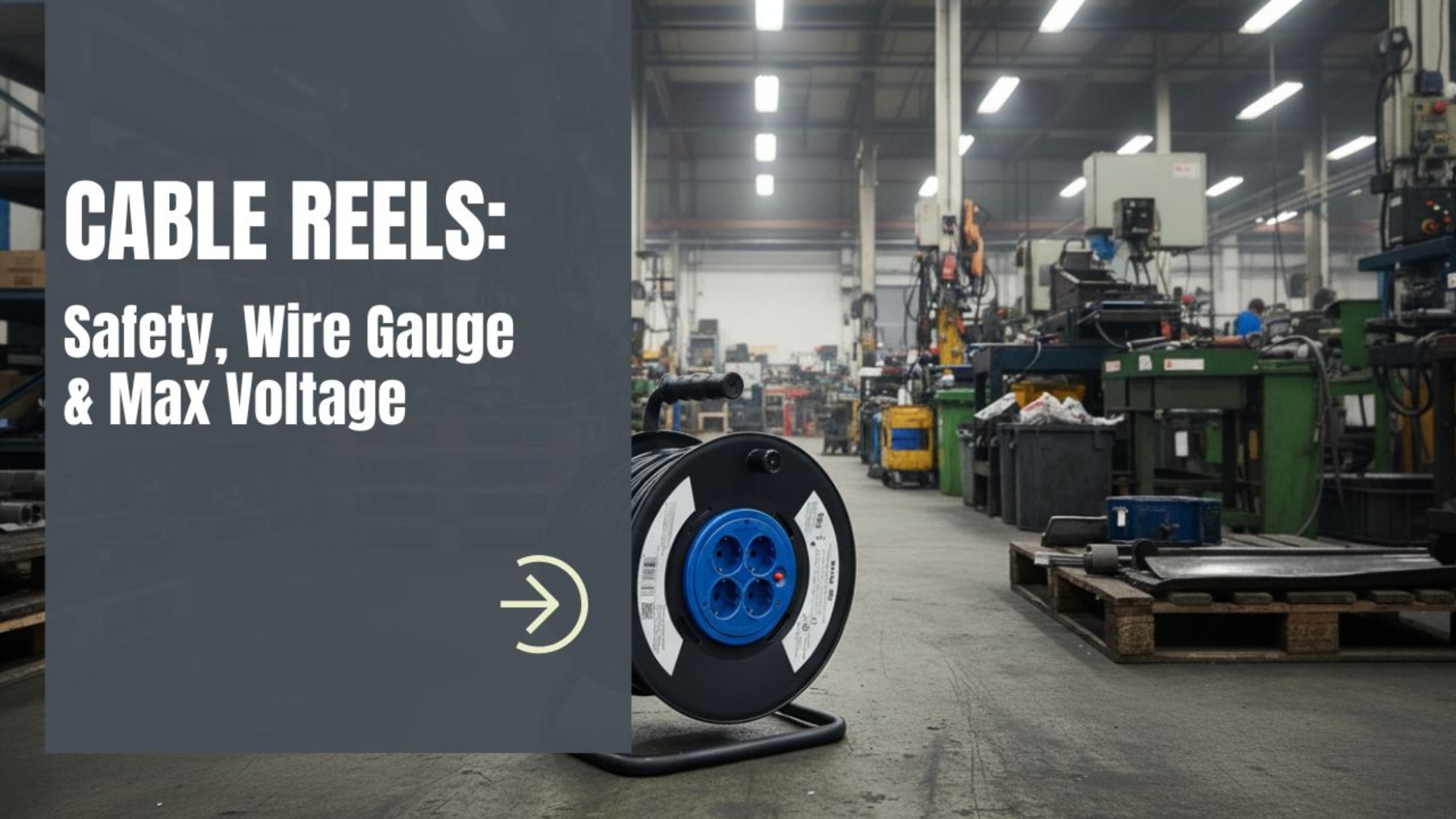
When we think about a cable reel, we usually look at the drum, the number of sockets or whether it includes thermal protection. However, the cable itself (its designation, insulation and cross-section) is what most determines the intended use, the maximum output and the durability of the unit. Choosing well not only prevents thermal trips or voltage drop: it also reduces faults, short circuits and unnecessary risks on site or at home.
This practical guide explains why not all cable reels perform the same, how to read the harmonised designation of cables (H05VV-F, H07RN-F, H07BQ-F…), the differences between 300/500 V and 450/750 V, and how to pick the right cross-section and length. We finish with a summary table, usage and maintenance tips, and a link to the Solera Cable Reels range. In that category you’ll see typical maximum ratings up to 3680 W at 230 V for selected models, which is a helpful reference point.
1) Why the cable matters as much as the drum
A cable reel brings together thermal limits (Joule heating, poorer dissipation when the cable is coiled), electrical limits (voltage drop over longer runs) and mechanical limits (abrasion, impact, repeated flexing). The combination of enclosure material, insulation type and cross-section determines whether the reel is for domestic, professional or industrial use, and what power it can safely deliver with the cable fully unreeled or partially/fully coiled.
That’s why, at the same length and with the same number of sockets, a reel fitted with H07RN-F 3G2.5 will handle scenarios that wouldn’t be appropriate for H05VV-F 3G1.5. The product label and data sheet set the admissible power at 230 V for both conditions (unreeled / coiled). Real-world examples show ≈3200–3500 W unreeled and ≈1000–1200 W coiled depending on model and cable, illustrating the strong derating when operating without unreeeling the drum.

2) How to read harmonised cable designations (H05/H07, VV, RN-F, BQ-F…)
The cable “number plate” summarises its rated voltage, materials and construction:
- H05… → harmonised cable for 300/500 V (domestic/light-duty environments).
- H07… → harmonised cable for 450/750 V (more demanding/industrial duty).
- VV → PVC insulation and sheath. Example: H05VV-F.
- RN → neoprene rubber (excellent mechanical and oil resistance). Example: H07RN-F.
- BQ → polyurethane (very high abrasion, cut and chemical resistance). Example: H07BQ-F.
- F → flexible stranded conductor (ideal for reels, extension leads, etc.).
Catalogues and data sheets link these designations to typical uses: for instance, reels with H07RN-F 3G2.5 for construction sites or industry (30 m with a reference maximum of ≈3500 W when unreeled, depending on model) versus reels with H05VV-F 3G1.5 aimed at domestic/light service.
3) 300/500 V vs 450/750 V: what actually changes
The pair of voltages (for example, 300/500 V or 450/750 V) defines the insulation and safety margins of a cable against dielectric stress. For the same cross-section, an H07 (450/750 V) tolerates harsher environments than an H05 (300/500 V), accepts more demanding bending radii and service temperatures, and maintains integrity better over long duty cycles.
That does not automatically mean “more power”, because reel power is also limited by the assembly’s thermal dissipation (drum + winding + environment), but it does enable professional use with greater robustness and service life. In practice, you’ll see H07RN-F on reels for workshops, sites and outdoor use, and H05VV-F for indoor/light-duty work.
4) The most common cables on Solera reels
4.1 H05VV-F (flexible PVC, 300/500 V) – domestic and light-duty
The classic choice for dry indoor environments: good cost/performance, a flexible feel and multiple length options. Typical reel builds: 3G1.5 mm² (with earth). Reference power values at 230 V, depending on model: ≈3200–3500 W unreeled and ≈1000–1200 W coiled. These figures show the coiling-related derating; the product label is the rule.
4.2 H07RN-F (neoprene rubber, 450/750 V) – industrial, site and outdoor
Offers superior resistance to oils, abrasion and impact, keeps flexibility in the cold and copes with demanding conditions. Very common in 3G2.5 mm² for 20–40 m. Solera catalogues list reference powers around ≈3500 W at 230 V (unreeled), depending on the reel configuration. Always check the specific model data sheet.
5) Length, cross-section and power: how they fit together
Maximum power at 230 V is not just P = V · I. On cable reels the key constraint is thermal: the more cable remains coiled, the worse the heat dissipation. That’s why all quality reels state two limits: “power unreeled” (higher) and “power coiled” (much lower). A real Solera data-sheet example for a 3G1.5 shows ≈3500 W unreeled and ≈1000 W coiled.
On top of that, voltage drop increases with length. With sensitive tools or motors, that drop raises current and aggravates heating. A good rule of thumb: if you need higher loads, step up the cross-section (e.g., from 1.5 mm² to 2.5 mm²) and fully unreeel the cable during sustained use.

6) Summary table (orientation based on real product types)
The table below condenses indicative ranges taken from real Solera products and catalogues. Exact limits depend on the model (sockets, protection, drum ventilation, etc.). Always verify the label/data sheet.
| Designation & build | Cross-section / Typical length | Max power unreeled (230 V) | Max power coiled (230 V) | Notes |
|---|---|---|---|---|
| H05VV-F (PVC, 300/500 V) | 3G1.5 / 20–40 m | ≈ 3200–3500 W* | ≈ 1000–1200 W* | Domestic/light duty; follow the reel’s label. |
| H07RN-F (neoprene, 450/750 V) | 3G2.5 / 20–40 m | ≈ 3500 W** | “Derate heavily” (see data sheet) | Industrial/site/outdoor; e.g., 30 m ≈ 3500 W unreeled. |
*Example: Solera product documentation shows reference values of ≈3500 W unreeled and ≈1000–1200 W coiled for 3G1.5; check the specific model sheet.
**Example from Solera catalogues: 30 m reel with H07RN-F 3G2.5 with a reference of ≈3500 W (unreeled).
7) The “silent” enemy: heating with a partially coiled cable
Running a reel with the cable partially coiled is one of the most common mistakes. The wound cable behaves like a “heated resistor” with far poorer air convection; that’s why manufacturers state a much lower limit in this condition. Several Solera models, for example, explicitly indicate ≈1000–1200 W when coiled versus ≈3200–3500 W unreeled. That’s normal and it’s for safety. If you’re powering medium/high loads (heaters, compressors, site equipment), always fully unreeel the cable.
8) Choosing by environment: indoor dry, demanding outdoor and site
- Indoor dry / events: H05VV-F 3G1.5 is usually sufficient. Watch longer runs to avoid undue voltage drop with sensitive kit.
- Demanding outdoor (occasional dust/water): go for H07RN-F / H07BQ-F and robust housings. If there’s moisture or wash-down, prioritise sockets/plugs and enclosures with an appropriate IP rating. (You’ll find practical IP guidance in Solera’s English site resources.)
9) Good practice for use and maintenance
- Always unreeel the cable for medium/high loads. If the reel states two power values (unreeled/coiled), obey them.
- Right cross-section: for demanding duty and lengths >20–25 m, consider 3G2.5. (Check your model’s reference rating.)
- Avoid tight “pancakes” of cable (coiled tightly in sun/high ambient temperatures). Heat worsens insulation performance and accelerates ageing.
- Inspect for cuts, drum dents, loose sockets and the thermal trip click. Replace the assembly if there’s serious damage.
- Outdoors and moisture: use connectors with the right IP rating and, where appropriate, an upstream RCD. Solera’s English resources include guidance for safe use in damp environments.
- Storage: clean before winding in, keep dry and avoid stacking weight on top. PU sheaths (H07BQ-F) withstand abrasion/chemicals better for intensive duty.
- Labelling: don’t cover or remove the power label. It’s your quick on-site reference and prevents errors.
- Surges and disturbances: long runs and switched-mode equipment are more sensitive to overvoltage; adequate protection in the distribution board helps maintain continuity of service.
10) Real-world pointers
- H05VV-F 3G1.5 – 25–40 m: reference values around ≈3500 W unreeled and ≈1000–1200 W coiled. If you’re feeding heaters, small compressors or several light-duty tools at once, fully unreeel.
- H07RN-F 3G2.5 – 30 m: reference around ≈3500 W unreeled. Suited to outdoor and heavy service. For continuous high load, move up to 2.5 mm² and mind the distance.
These ranges underline two key messages: (1) the cable and its cross-section define the reel’s “league”; (2) coiled cable = dramatically lower power. The model’s label is the rule—always follow it.
11) Quick checklist before you plug in
- Does the environment (indoor, outdoor, site) match the cable type?
- Is the cross-section appropriate for the load and the run length you need?
- Does the reel include thermal protection? Prefer reels that do.
- Using it on continuous load? Fully unreeel.
- Are your sockets and connectors rated with the right IP if dust/water is present?
12) Conclusion
Cable reels are not “all the same”: the cable (H05VV-F vs H07RN-F vs H07BQ-F), the cross-section (1.5 mm² vs 2.5 mm²), the length and the coiling state determine the real-world, safe power you can draw at 230 V. Use the harmonised designation as your compass, respect the power label (both “unreeled” and “coiled”), and choose by environment: indoor (H05VV-F) versus site/outdoor (H07RN-F). If you need a starting point with real figures, explore the Solera Cable Reels family and each model’s data sheet (you’ll find reference maxima such as ≈3680 W at 230 V in certain configurations).
With the right selection and correct operation (unreeel fully, consider the environment, maintain properly), your reel will run cooler, safer and for longer. And if you also look after sockets, protection devices and board assembly, you’ll cut everything from nuisance trips to overvoltage incidents, making the whole system more robust.